
EraNova Announces Positive Preliminary Economic Assessment for the Adanac Molybdenum Project: After-Tax NPV of $714.4 Million and 23.5% IRR
Study confirms Adanac as a large-scale, long-life primary molybdenum development project with strong economics; project to advance directly toward Feasibility
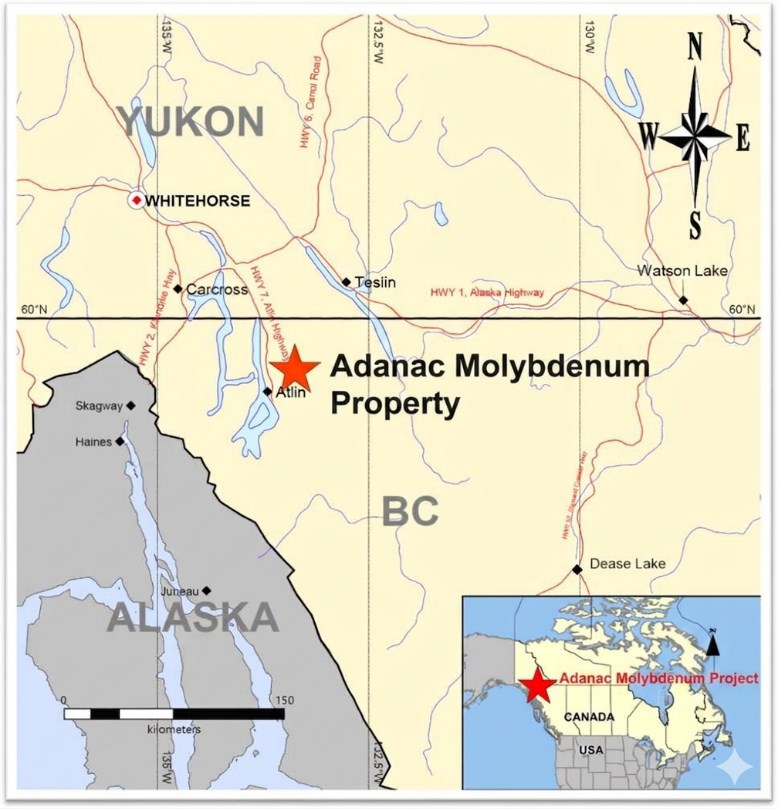
Vancouver, British Columbia--(Newsfile Corp. - August 6, 2026) - EraNova Metals Inc. (TSXV: NOVA) (OTCQB: STXPF) ("EraNova" or the "Company") announces results from an independent Preliminary Economic Assessment ("PEA") for its 100% owned Adanac Molybdenum Project ("Adanac" or the "Project"), located 35 km northeast of Atlin, British Columbia.
The PEA confirms Adanac as a large-scale, long-life primary molybdenum development project with strong economics and an advanced development foundation. Supported by decades of historical engineering, a previously issued Environmental Assessment Certificate ("EAC"), established road access and more than C$100 million in historical infrastructure investment, the Company's focus will now be on initiating a Feasibility Study while obtaining an updated environmental assessment and the permits required to support future project development.
PEA Highlights
Long-Life Primary Molybdenum Project: 30,000 tonnes-per-day ("tpd") open-pit mining and processing operation with a 24-year mine life, averaging 11.4 million pounds of molybdenum produced annually and 270.1 million pounds of payable molybdenum over the life of mine. The Project's scale and longevity provide exposure to multiple molybdenum price cycles.
Strong Project Economics: Robust economics under both the base case and current spot molybdenum price assumptions, generating approximately C$2.0 billion in cumulative after-tax free cash flow under the base case, increasing to approximately C$3.6 billion at current spot molybdenum prices. Key unlevered economic results are summarized below.
Table 1 - Adanac Molybdenum Project PEA Pre-Tax and After-Tax Economic Results Summary
| Molybdenum Price (US$/lb Mo) | US$25.00/lb¹- Base Case | US$31.91/lb - Spot Price2 |
|---|---|---|
| Pre-Tax NPV @ 8% | C$1,201.2M | C$2,105.8M |
| Pre-Tax IRR | 30.8% | 38.9% |
| After-Tax NPV @ 8% | C$714.7M | C$1,292.2M |
| After-Tax IRR | 23.5% | 30.2% |
| After-Tax NPV / CAPEX | 75% | 136% |
¹ LOM average 2 Molybdenum spot price as of July 29, 2026 (USD:CAD 1.00:1.39).
3 Project economics are presented on an unlevered basis and do not assume project debt or other financing arrangements.
Existing Infrastructure Reduces Development Risk: More than C$100 million of historical infrastructure investment, established road access and a previously issued Environmental Assessment Certificate provide an advanced development foundation, positioning the Project to advance directly toward a Feasibility Study.
Capital Efficiency: Initial capital of C$953.3 million, including $120.7 million contingency, supports the development of a 30,000 tpd operation. Estimated cash costs are US$17.48/lb Mo and AISC1 are US$19.79/lb Mo.
Resource Confidence Built In: 93% of the mine plan's pounds are classified as Measured and Indicated, providing a solid foundation for advancement.
Exploration Optionality: The Atlin Discovery Project provides district-scale polymetallic exploration upside beyond the Adanac development case.
1 AISC is a non-GAAP measure. See "Use of Non-GAAP Financial Measures" below.
"This PEA confirms what we have long believed the Adanac Project was capable of-a large-scale, long-life primary molybdenum development project with strong economics and a clear pathway toward development," said Meredith Eades, President and CEO of EraNova Metals. "Adanac is the product of decades of engineering and development work. Established road access, a previously issued Environmental Assessment Certificate and more than C$100 million in historical infrastructure investment provide a more advanced development foundation than is typical of a greenfield project. With the PEA now complete, our focus shifts to executing the next stage of Project advancement by initiating a Feasibility Study, advancing the environmental assessment process and engaging with strategic partners to help move Adanac toward development."
The Company will host a live Investor Webinar at 12PM ET/9AM PT on Monday, August 10, 2026, to present the PEA results. Register at www.eranovametals.com/pea. A recording of the webinar will be made available on the Company's website following the event.
Description of the PEA
The PEA outlines a conceptual development scenario for the Adanac Project based on the updated Mineral Resource Estimate ("MRE") (see "Mineral Resources" below), incorporating conventional openpit mining and onsite molybdenum recovery through a 30,000 tpd processing facility.
The PEA was prepared by Tetra Tech Canada Inc. ("Tetra Tech") in accordance with National Instrument 43-101 - Standards of Disclosure for Mineral Projects ("NI 43-101").
This PEA is preliminary in nature. It includes Inferred Mineral Resources that are considered too speculative geologically to have economic considerations applied to them that would enable them to be categorized as mineral reserves. There is no certainty that the PEA will be realized. Mineral resources that are not mineral reserves do not have demonstrated economic viability.
The NI 43-101 Technical Report supporting the PEA will be filed on SEDAR+ (www.sedarplus.ca) and on the Company's website within 45 days of this news release.
Project Overview
The 100%-owned Adanac Molybdenum Project is located approximately 35 km northeast of Atlin, British Columbia by road, within the traditional territory of the Taku River Tlingit First Nation, and forms part of EraNova's district-scale Ruby Creek Property, which also hosts the Company's Atlin Discovery Project.
Adanac is a large-scale primary molybdenum development project that has benefited from decades of exploration, engineering and development. Since its discovery in the late 1960s, multiple operators have advanced the Project through more than 73,000 metres of drilling, underground bulk sampling, feasibility studies, environmental assessment and the commencement of mine construction before development was suspended following the 2008 global financial crisis.
Today, the Project benefits from established road access, more than C$100 million in historical infrastructure investment and a previously permitted mine development concept, providing an advanced development foundation compared with a typical greenfield project.
Infrastructure supporting the Project includes proximity to the community of Atlin, British Columbia (population approximately 500), a registered public-use airport (CYSQ) supporting charter and general aviation, access to the Port of Skagway, Alaska (approximately 275 km), and the proposed BC-Yukon Grid Connect, a cross-border transmission initiative intended to strengthen regional power infrastructure and support future economic development. Together, these attributes position Adanac as a more advanced development opportunity than a typical greenfield project and provide a strong foundation for the next stage of engineering.
Figure 1 - Adanac Molybdenum Project Site Location Map
Base Case Economic Results
The PEA for Adanac is based upon a subset of mineral resources comprising 93% Measured and Indicated and 7% Inferred mineral resources.
With approximately 93% of the mine plan supported by Measured and Indicated Mineral Resources, the Project benefits from a high level of resource confidence, providing a strong foundation for future engineering studies and reducing the need for additional resource definition drilling as the Project advances.
Table 2 - Adanac Molybdenum Project PEA Base Case Economic Results in Detail
| Description | Unit | Value |
|---|---|---|
| Metal Price | ||
| Molybdenum Price (Average) | C$/lb | 34.75 |
| US$/lb | 25.00 | |
| Production | ||
| Mine Life | Year | 24 |
| Mill Feed Tonnage, LOM | Mt | 252.0 |
| Mill Feed Grade, LOM | % Mo | 0.054 |
| Concentrate Grade | % Mo | 54.0 |
| Molybdenum Recovery to Concentrate | % | 90.2 |
| Molybdenum Produced, LOM | klb | 272,848 |
| Annual | klb | 11,369 |
| Operating Costs, LOM | C$M | 3,822.8 |
| Unit | C$/t | 15.17 |
| Operational Revenue | C$M | 4,663.5 |
| Cash Cost | C$/lb | 17.48 |
| AISC | C$/lb | 19.79 |
| Capital Costs | ||
| Initial Capex (including Mining Pre-production Cost) | C$M | 953.3 |
| Sustaining & Closure | C$M | 625.1 |
| Total Capital Costs (excluding Salvage Cost) | C$M | 1,578.4 |
| Economic Results | ||
| Discount Rate | % | 8% |
| Pre-Tax NPV @ 8% | C$M | 1,201.2 |
| US$M | 864.2 | |
| Pre-Tax IRR | % | 30.8% |
| Pre-Tax Simple Payback | Year | 2.3 |
| After-Tax NPV @ 8% | C$M | 714.7 |
| US$M | 514.2 | |
| After-Tax IRR | % | 23.5% |
| After-Tax Simple Payback | Year | 2.6 |
Notes
1. Cash cost per pound reflects direct mining, processing, site general & administrative, refining, transport, and royalty costs, divided by payable molybdenum pounds.
2. All-In Sustaining Cost ("AISC") per pound includes cash costs plus sustaining capital, sustaining exploration, and site-level closure costs, divided by payable molybdenum pounds. Growth capital, corporate G&A, financing costs, and income taxes are excluded.
3. Initial Capex represents upfront expenditures to construct and commission the mine, plant, and supporting infrastructure.
4. Sustaining Capex represents ongoing capital expenditures required to maintain production during the life of mine.
5. Payback Period represents years from start of commercial production to achieve cumulative positive after-tax free cash flow, including sustaining capital.
6. Exchange rate assumption: $1.39 CAD per $1.00 USD.
7. Non-GAAP financial measures are presented for additional information and benchmarking purposes only. See "Use of Non-GAAP Financial Measures."
Sensitivity
After-Tax Sensitivity Summary
The Project's economics were evaluated across a range of changes to key project variables. The sensitivity analysis indicates that project value is driven primarily by changes in the molybdenum price, followed by operating costs and capital costs. The sensitivity of the Project's after-tax NPV8% and IRR to these variables is illustrated in the figures below.
Figure 2A - Adanac Molybdenum Project PEA After-Tax NPV Sensitivity (+/-30%)
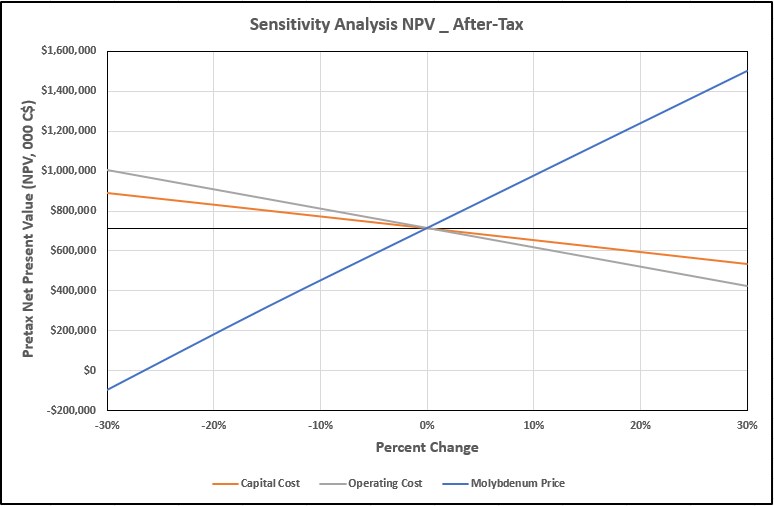
Figure 2B - Adanac Molybdenum Project PEA After-Tax IRR Sensitivity (+/-30%)
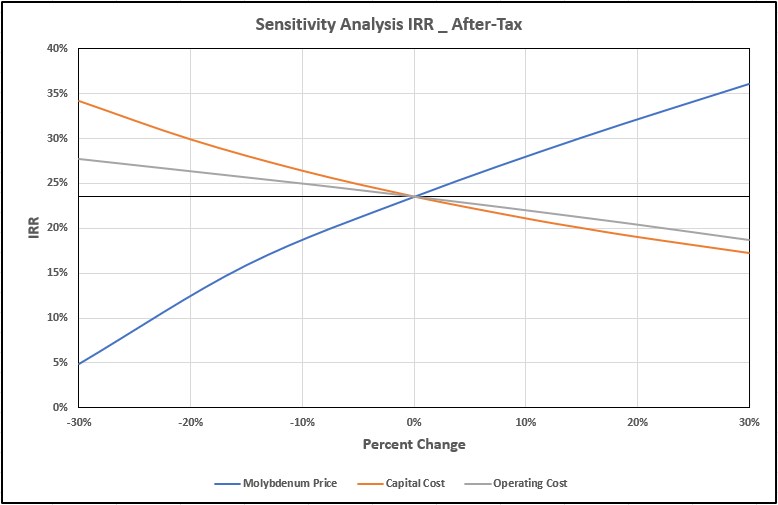
The sensitivity analysis demonstrates meaningful leverage to higher molybdenum prices while underscoring the resilience and strength of the Project across a broad range of capital and operating cost assumptions.
Capital and Operating Costs
Initial CAPEX: C$953.3M, including contingency of C$120.7M and C$3.9M mining initial operating costs.
Sustaining Capital: C$625M over LOM Salvage Value: C$24M can be recovered at the end of mine line Operating Costs: C$15.17/t milled, including mining (41.8%), processing (44.4%), and G&A and site services (13.8%).
Closure Costs: C$50M at end of mine life.
Mineral Resources
An updated Mineral Resource Estimate ("MRE"), effective date August 6, 2026, was prepared by Tetra Tech in accordance with CIM Guidelines and NI 43-101 and replaces the previous MRE with an effective date of March 10, 2022.
The updated MRE incorporates the current geological interpretation and forms the basis of the 24-year mine plan evaluated in the PEA.
Table 3 - Adanac Molybdenum Project PEA Mineral Resource Statement, effective date August 6, 2026
| Classification | Tonnes (Mt) | Mo Grade (% Mo) | Contained Mo (Mlbs) |
|---|---|---|---|
| Measured | 39.0 | 0.072 | 61.7 |
| Indicated | 352.2 | 0.048 | 374.1 |
| Measured + Indicated | 391.2 | 0.051 | 435.7 |
| Inferred | 76.4 | 0.042 | 71.0 |
Notes
1. Mineral resources are not mineral reserves and do not have demonstrated economic viability.
2. Mineral resources are reported at a cut-off grade of 0.02% Mo, constrained within a conceptual open-pit shell.
3. Mineral resources are reported based on a long-term molybdenum price of US$23/lb Mo.
4. Classification is consistent with the 2014 CIM Definition Standards for Mineral Resources and Mineral Reserves.
5. All figures are rounded to reflect the relative accuracy of the estimate; numbers may not add due to rounding.
6. The estimate of mineral resources may be materially affected by environmental, permitting, legal, title, taxation, socio-political, marketing, or other relevant issues.
Mining Method
The Adanac Molybdenum Project is planned to be developed using conventional open-pit mining methods, including drilling, blasting, loading, and hauling with large-scale mining equipment. Material will be drilled and blasted, then loaded into diesel-powered haul trucks using a fleet of hydraulic shovels and front-end wheel loaders.
To identify the optimal pit size and mining sequence, Tetra Tech used Datamine™ NPVS software for pit optimization. Datamine™ employs the Lerchs-Grossmann (LG) algorithm to evaluate the net value of individual blocks within the block model. Molybdenum pricing for the pit optimization is based on monthly trailing average over medium to long-term periods. An assumed molybdenum price of US$23 per pound (Mo) has been applied. Life of mine (LOM) operating costs were based on previous technical studies.
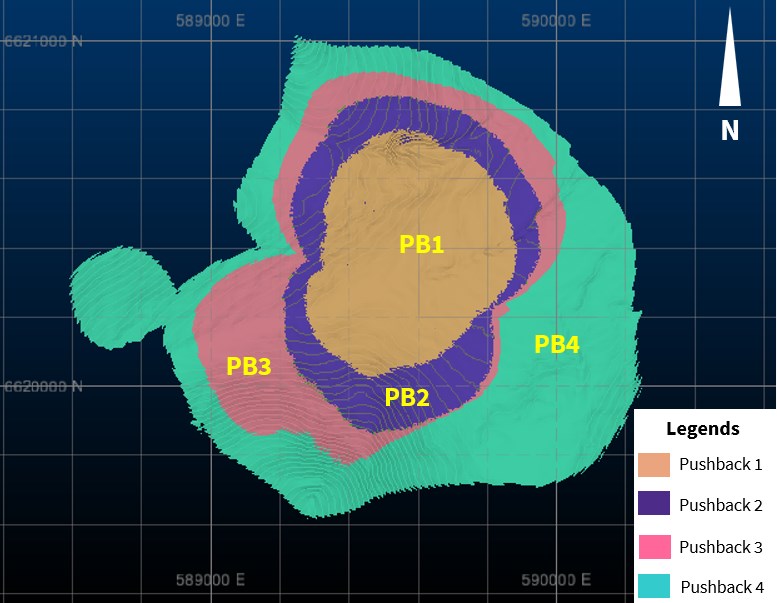
Guided by the pit optimization process, four pushbacks have been designed and incorporated into the mining sequence to bring higher grade material forward and to defer a large quantity of waste rock stripping (table below). Pushbacks were designed to provide operational flexibility. For most of the LOM, there are at least two active pushbacks being mined at one time, reducing the loading requirements and allowing progressive sustaining capital expenditures. The figure below shows the total mining quantities with pushback schedule.
Table 4 - Adanac Molybdenum Project PEA Open Pit Mine Pushback Design
| Total Mined (Mt) | Waste (Mt) | Mill Feed (Mt) | Strip Ratio |
|---|---|---|---|
| 58.7 | 10.3 | 48.4 | 0.2 |
| 71.7 | 22.6 | 49.2 | 0.5 |
| 73.9 | 32.0 | 42.0 | 0.8 |
| 218.5 | 106.0 | 112.5 | 0.9 |
| 422.9 | 170.9 | 252 | 0.7 |
Pushback Grade (%)
PB1 0.07 PB2 0.06 PB3 0.05 PB4 0.05
Total 0.05
Figure 3 - Adanac Molybdenum Project PEA Open Pit Mine Pushback Schedule
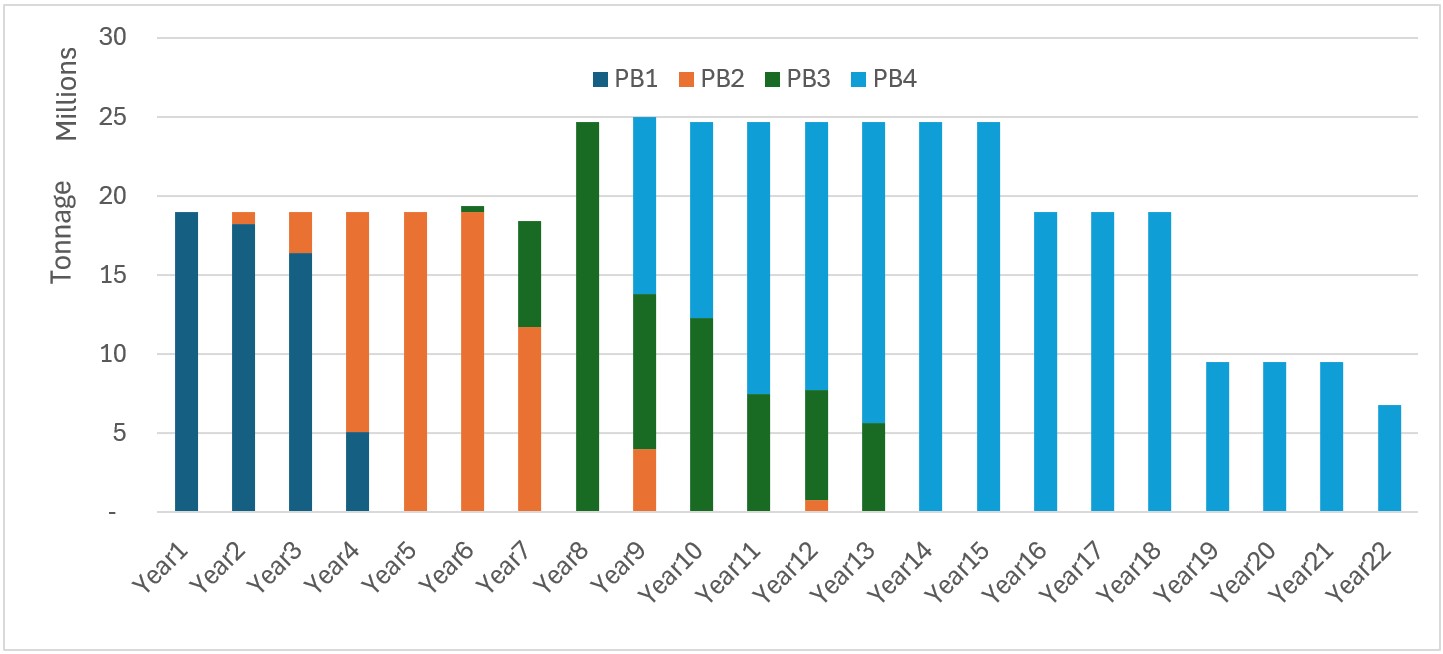
The life-of-mine plan comprises 22 years of active mining operations followed by two years of low-grade stockpile processing. Mining is conducted at a consistent rate of 19.0 Mt of material annually during the first seven years before increasing to 24.7 Mt, maintaining steady operational performance with an average strip ratio of 0.7:1. The process plant is designed for a nominal throughput of 30,000 tonnes per day (approximately 11.0 million tonnes per year). Average molybdenum production over the 24-year mine life is estimated at approximately 11.4 million pounds per year. Mill throughput is planned at 75% of nameplate capacity in Year 1 and 100% from Year 2 onward, allowing for a controlled start-up and optimization of plant performance. The figure below illustrates the proposed pit pushback sequence.
Figure 4 - Adanac Molybdenum Project PEA Open Pit Mine Pushback Map
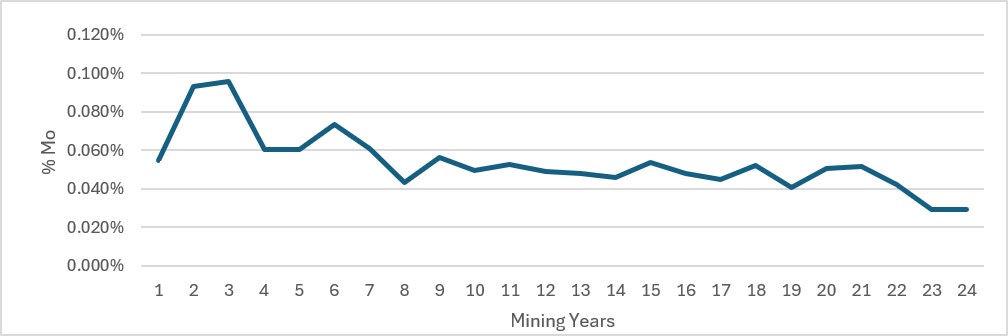
A stockpile strategy has been defined to feed the process plant with the highest-grade material at the start of the operation and stockpile the lower grade material to be processed in the later years. The goal was to optimize the pit to schedule the high-grade mill feed as early as possible and process the lowgrade mill feed contained inside the pit at the end of the LOM. The figures below show the dynamic mill feed and average mill feed grade, respectively.
Figure 5 - Adanac Molybdenum Project PEA Mill Feed Schedule
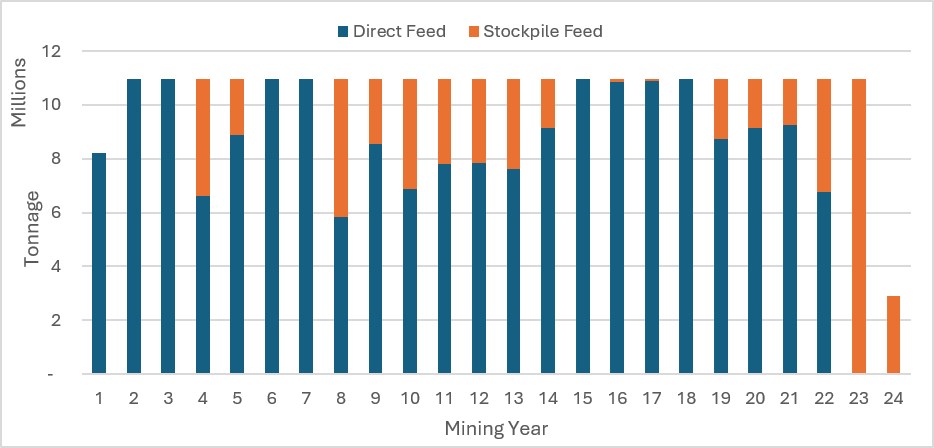
Figure 6 - Adanac Molybdenum Project PEA Open Pit Mine Mill Feed Grade Schedule
Processing
Comprehensive metallurgical test work on the Adanac mineralized material was completed prior to 2006 in support of earlier studies. The materials demonstrated a good response to conventional flotation processing. The test work includes comminution characterization, flowsheet development and flotation condition optimization, including regrind size determination and product settling tests. The test results indicated that molybdenum recoveries of more than 90% are achievable.
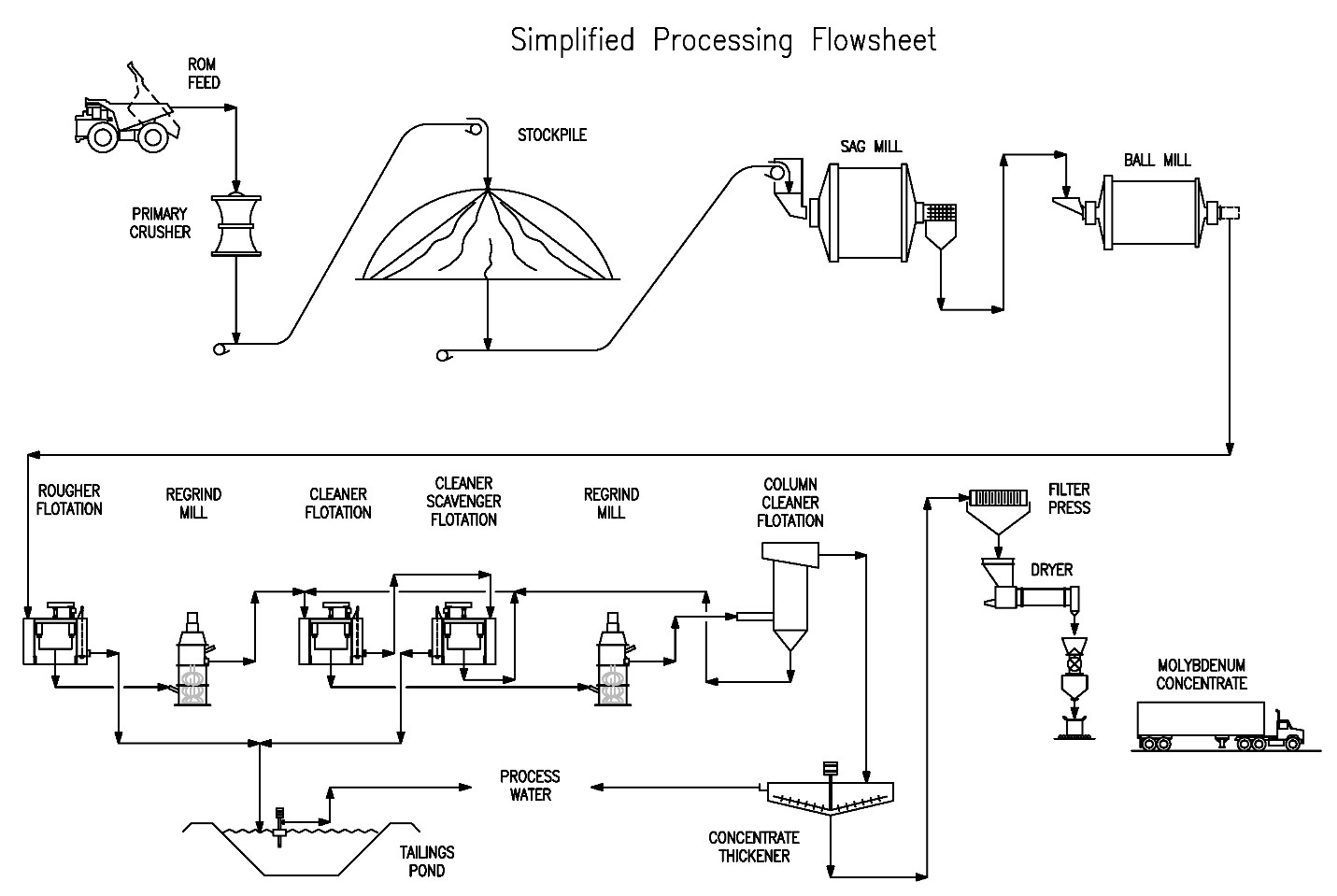
Based on the test work results, the optimized flowsheet was developed for this study. The process flowsheet is designed for 30,000 tpd and follows a conventional molybdenite flotation circuit to produce a high-grade molybdenum concentrate, which will be further processed at an offsite roasting facility. The processing plant (see simplified process flow diagram below) will consist of the following:
A primary crusher with crushed material stockpiling, followed by a SAG-ball mill (SAB) grinding circuit.
Rougher flotation with a concentrate regrind circuit.
Cleaner flotation comprising a first-stage cleaner and cleaner-scavenger, followed by a second regrind stage.
Multi-stage column cleaner flotation producing a final saleable concentrate.
Concentrate thickening followed by pressure filtration and drying prior to packaging and shipment. Associated utility and reagent systems.
Figure 7 - Adanac Molybdenum Project PEA Simplified Process Flowsheet
Infrastructure
The Project benefits from existing transportation infrastructure, proximity to future regional power initiatives and favourable site characteristics that support future development, including:
Road Access: The Adanac Molybdenum Project is accessible from Atlin, British Columbia by road, approximately 35 km away. Atlin provides year-round road access to Whitehorse, YT (approximately two hours), and ice-free deep-water Port of Skagway, Alaska (about 3.5 hours providing efficient logistics for project construction, operation, and molybdenum concentrate shipment to the Asian markets.
Power: At the conceptual level, the Project may benefit from future regional hydroelectric infrastructure, including the proposed Atlin Hydro Expansion Project and the BC-Yukon Grid Connect initiative. Both remain subject to future planning, regulatory approvals, consultations and agreements with the relevant agencies and utilities.
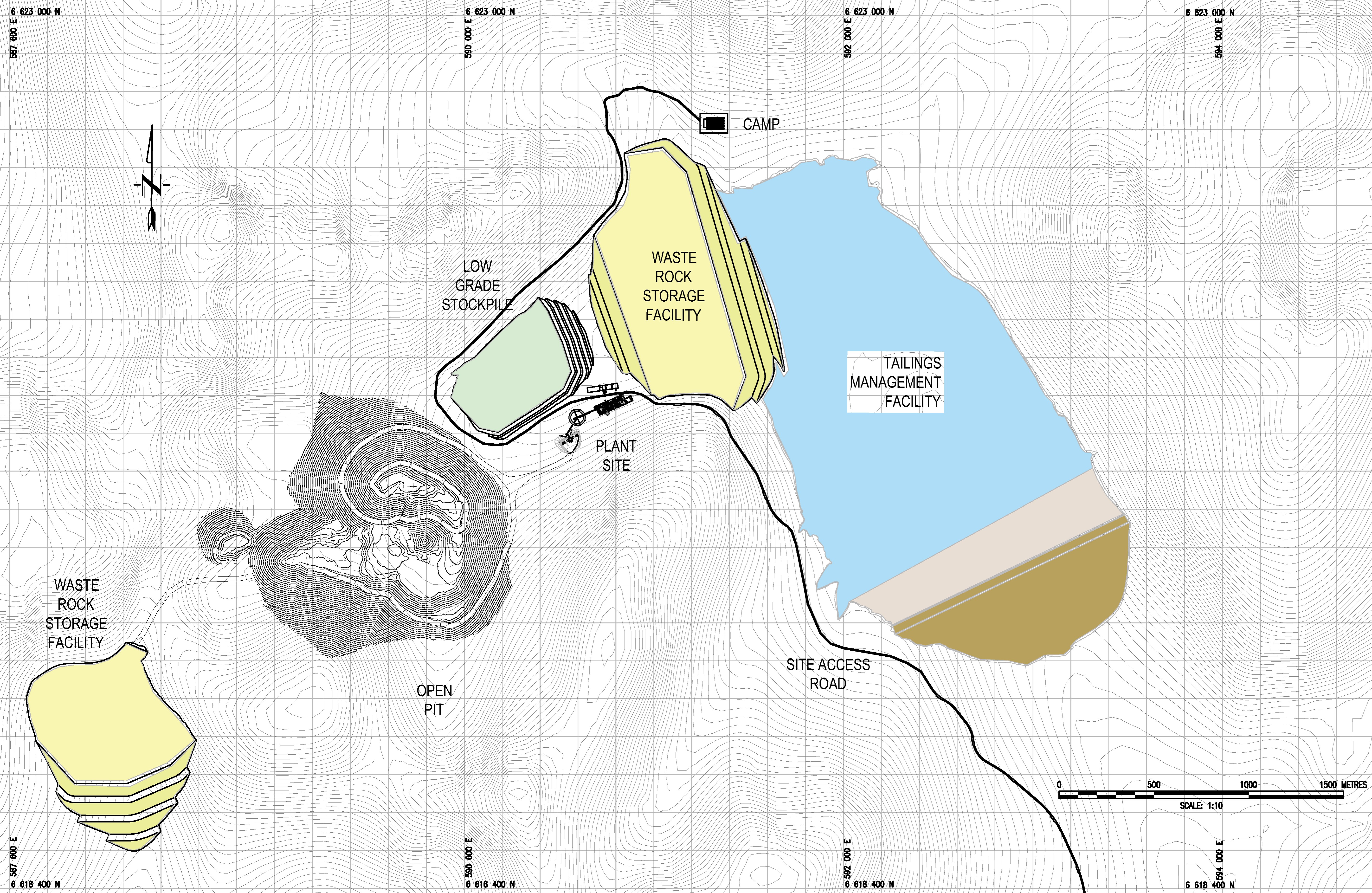
Water: Several surface water bodies are located near the project site and are expected to provide suitable water sources for future operations, subject to detailed engineering and permitting. Tailings Management Facility ("TMF"): A natural valley proximal to the deposit provides a suitable topographic setting for tailings containment. Cyclone processing of the tailings will generate sand fractions for use as TMF embankment construction material, thereby reducing the volume of imported or conventionally sourced fill and lowering overall embankment construction costs. Tailings will be deposited sub-aqueously to maintain saturated conditions, limit oxygen ingress, and reduce the potential for acid rock drainage generation.
Camp and Services: A 160-person accommodation camp is planned to support construction and operations. Camp services are expected to be provided by third-party contractors, creating potential business and employment opportunities for nearby Indigenous communities.
Overall Site General Arrangement: The overall site arrangement is presented in the figure below.
Figure 8 - Adanac Molybdenum Project PEA Overall Site General Arrangement Plan
Environmental, Social, and Permitting
The Project is located within the traditional territory of the Taku River Tlingit First Nation. EraNova is committed to meaningful engagement with the Taku River Tlingit First Nation throughout all stages of Project advancement.
A previous EAC was issued for Adanac in 2007, reflecting the advanced stage of historical project development and providing a strong foundation for future environmental assessment and permitting efforts. The Company intends to build on this work as it advances the Project toward a Feasibility Study and future development.
Opportunities and Exploration Potential
The PEA presents a conceptual development scenario for Adanac based on current information. The following opportunities may be evaluated in future technical studies to further optimize the Project's technical and financial performance.
Power Optimization
EraNova intends to evaluate opportunities to connect the Project to regional clean power infrastructure, including the proposed BC-Yukon Grid Connect initiative or other future grid connection alternatives. Access to grid power could reduce operating costs and greenhouse gas emissions compared with onsite diesel power generation and may support increased electrification of mining and processing equipment in future development scenarios.
Government and Critical Minerals Funding Opportunities
Molybdenum is included on Canada's critical minerals list. EraNova intends to evaluate available federal and provincial funding, infrastructure and strategic investment programs that may support future engineering, infrastructure development and project advancement.
Closure Cost Refinement
The PEA applies a conservative estimate for closure costs. Additional geochemical and hydrological and site-specific engineering studies may allow estimates to be further refined in subsequent technical studies.
District-Scale Exploration Optionality
The Atlin Discovery Project provides district-scale exploration upside beyond the Adanac development case, creating an additional opportunity for long-term value creation across the broader Ruby Creek Property. In addition to high-grade gold, silver and copper targets, the Property hosts significant tungsten mineralization spatially associated with the Ruby Creek Molybdenum Deposit, providing opportunities to further evaluate and potentially enhance long-term project value through future exploration.
Targets include:
Silver Surprise: High-grade silver target located approximately 7 km northeast of the Ruby Creek Molybdenum Deposit, where a 1,585-pound surface mini-bulk sample averaged 4,200 g/t silver and achieved 95% silver recoveries from direct smelting. (See December 1, 2025 news release.) Lakeview: Gold-silver target characterized by multiple steeply dipping quartz veins, where recent exploration identified visible gold and returned grab samples of up to 257 g/t gold and 3,660 g/t silver*. (See March 2, 2026 news release.)
Ruffner: Historic silver-producing area where recent exploration uncovered a potential coppergold porphyry system beneath historical high-grade silver mineralization, highlighting the potential for multiple deposit styles within the broader Ruby Creek Property.
Thor Ridge / Black Diamond Corridor (Tungsten): Historic and recent exploration has identified widespread tungsten mineralization associated with the Ruby Creek intrusive system, including historical values of up to 17% WO₃*. Much of the historical molybdenum drilling has not been systematically assayed for tungsten, representing an opportunity to evaluate the potential contribution of tungsten to the broader project.
- Grab samples are selective by nature and may not be representative of mineralization across the
property.
Next Steps/Path Forward
Advancing Engineering
The completion of the PEA establishes a strong technical foundation for the next stage of engineering. Given the extensive historical engineering completed at Adanac, the Company believes the Project is well positioned to advance directly to feasibility-level engineering.
Future work is expected to focus on metallurgical optimization, geotechnical and hydrogeological investigations, detailed mine, infrastructure and tailings engineering, environmental studies, and continued refinement of the Project's capital and operating cost estimates.
Engineering Support Drilling
The Company anticipates evaluating a targeted drilling program of approximately 3,000 metres to support feasibility-level engineering. The program would be expected to focus primarily on infill drilling, geotechnical investigations and metallurgical sample collection, rather than material mineral resource expansion.
Environmental & Permitting
In parallel with the Feasibility Study, EraNova intends to advance the environmental assessment process and obtain the regulatory approvals required to support future Project development, building on the substantial environmental studies and technical work completed during the previous Environmental Assessment process. The Company will continue to engage with the Taku River Tlingit First Nation,