
Los Andes Copper Announces Positive PFS for Vizcachitas with a US$2.77 Billion Post-Tax NPV and 24% IRR
Vancouver, British Columbia--(Newsfile Corp. - February 23, 2023) - Los Andes Copper Ltd. (TSXV: LA) (OTCQX: LSANF) ("Los Andes" or the "Company") is pleased to announce the results of a positive Pre-Feasibility Study ("PFS") at its 100% owned Vizcachitas Project ("Vizcachitas" or the "Project"), a world class porphyry copper project, located 150 km north of Santiago. The PFS has been prepared by Tetra Tech Sudamérica S.A, a leading international engineering firm. A conference call and webcast to discuss these results will be held on Friday, February 24, 2023, at 12.00 p.m. Eastern Standard Time. To register please contact [email protected] whereafter the webinar details will be sent to you. All values in this release are reported in US dollars.
To view a 3D VRIFY presentation of the PFS results, click on the following link: https://vrify.com/decks/12765
Vizcachitas PFS Highlights
Robust Economics
A $2.8 billion post-tax net present value ("NPV") using an 8% discount rate and an internal rate of return ("IRR") of 24% at $3.68/pound ("lb") copper, $12.9/lb molybdenum and $21.79/ounce ("oz") silver.
Pre-production capital cost of $2.4 billion, with a construction period of 3.25 years.
Payback period of 2.5 years from initial production.
World-Class Resource
Proven & Probable Reserves of 1.22 billion tonnes at 0.36% copper, 136 ppm molybdenum, 1.1 g/t silver, which equates to a copper equivalent ("CuEq") grade of 0.41% (Proven Reserves of 302 million tonnes at 0.41% copper, 135 ppm molybdenum, 1.2 g/t silver; and Probable Reserves of 917 million tonnes at 0.34% copper, 136 ppm molybdenum, 1.1 g/t silver).
Measured & Indicated Resources increased by 16% to 14.8 billion lbs CuEq (Measured Resource of 2.605 billion lbs copper, 84 million lbs molybdenum and 11 million oz silver, and Indicated Resource of 10.416 billion lbs of copper, 442 million lbs of molybdenum, and 43 million oz of silver) and Inferred Resource increased by 130% to 15.4 billion lbs CuEq (13.747 billion lbs copper, 495 million lb molybdenum, 55 million oz silver) with respect to the June 2019 Preliminary Economic Assessment ("PEA").
Long-Scale, Long-Life, High-Margin Production
Average annual production of approximately 183,017 tonnes of copper at a C1 cost of $0.93/lb copper (net of by-products) for the first 8 years.
Initial Project Life of Mine ("LOM") 26 years producing 8.763 billion lbs copper, 273.3 million lbs molybdenum, and 32.7 million oz silver.
Realized CuEq metal price (net of smelter return and selling expenses) of $3.50/lb copper sold, yielding a 44% all-in-sustaining margin.
Low strip ratio (waste:ore) of 1.54:1 for first 8 years, and strip ratio 2.33:1 for LOM.
Favourable metallurgy including low levels of clay, resulting in high copper recoveries (average of 91.1%) and supporting the use of filtered tailings.
Sustainable and Responsible Mining
Signed letter of intent for desalinated water, eliminating the need to draw on continental water. Reduced water consumption by approximately 50% (from previous design) through use of drystacked filtered tailings.
Reduced power consumption by 25% (from previous design) through use of high pressure grinding rolls ("HPGR") technology.
CO2 emissions Scope 1 projected at 1.02 h CO2e / t CuEq, and Scope 2 at 0.
Future Opportunities
Potential opportunities to meaningfully improve the Project include: (i) drilling to upgrade inferred resources and bring them into the mine plan potentially increasing the LOM, reducing operating expenses, capital expenses and strip ratio; and, (ii) further drilling to define the extent of mineralization, deposit currently open at depth, east and west.
An independent technical report for the PFS, prepared in accordance with NI 43-101, will be available under the Company's SEDAR profile within the next 45 days.
Los Andes Copper' CEO, Santiago Montt, commented on the PFS:
"I am extremely pleased to announce the results of the Pre-Feasibility Study for the proposed Vizcachitas mine in Chile. It shows that Vizcachitas is clearly a Tier 1 asset that has the potential to join the ranks as one of the largest and most profitable copper mines in Chile.
The new mine design incorporates a number of optimizations including expanding access works, allowing for a faster ramp-up of production and minimizing uphill material movement and haulage distances. This has reduced the OPEX and led to a shorter payback further strengthening the economics of the Project. Our new sustainable and responsible design considers the use of HPGR to reduce energy consumption, dry-stacked filtered tailings to reduce water consumption and footprint, and desalinated water.
Vizcachitas benefits from being situated in a country with an established mining industry and in close proximity to existing infrastructure including power, roads and ports. All of these factors have enabled the Project to meaningfully reduce its initial CAPEX requirement. There is also a skilled labor force in the nearby towns and cities of Putaendo, San Felipe and Los Andes.
The Project is economically robust with the potential for considerable upside through further drilling to upgrade the Inferred Resource to Measured and Indicated, thereby bringing them into the mine plan."
Los Andes Copper' Chairman, Eduardo Covarrubias, commented on the PFS:
"The lack of new discoveries of this scale over the last 10 years and the increasing demand for copper highlights the importance of projects like Vizcachitas. The PFS demonstrates a robust, economically attractive project with long mine life and potential for significant further upside.
The study focused on ensuring Vizcachitas would lead the way in sustainable mining, and we are delighted to announce that our three key targets: to reduce water usage, power consumption and the footprint of the Project have all been met, allowing us to deliver a mine that minimizes its impact on the environment."
Project Description
The Vizcachitas Project is located in the Andes Mountains, in the Province of San Felipe, Fifth Region of Chile, approximately 150 km northeast of Santiago, Chile, and 46 km northeast of Putaendo, San Felipe Province. The Project is 100% owned by Los Andes Copper Ltd., a company based in Vancouver and listed on the TSX Venture Exchange. The Project is located at just 1,950 m.a.s.l., in proximity to other world-class copper-molybdenum porphyries that belong to the same metallogenic belt.
The Vizcachitas Project is a mineralized copper-molybdenum porphyry system associated with a complex of hydrothermal breccias and porphyries within Miocene volcanic rocks. The Vizcachitas Project contains Measured and Indicated Resources of 14.801 billion pounds CuEq (Measured Resource of 2.605 billion lbs copper, 84 million lbs molybdenum and 11 million oz silver, and Indicated Resource of 10.416 billion pounds of copper, 442 million lbs of molybdenum, and 43 million oz of silver) and Inferred Resources of 15.444 billion pounds CuEq (13.747 billion lbs of copper, 495 million lb of molybdenum, and 55 million oz of silver). It is one of the largest undeveloped copper projects in South America not controlled by a major mining company.
The PFS contemplates that Vizcachitas would be mined using conventional open pit methods. From the open pit the ore would be trucked to a concentrator designed to process 136,000 tonnes per day of ore. The ore would be fed into a three-stage crushing plant using HPGR technology as the tertiary crusher. The ore would be crushed to 240 microns, and sent as a slurry to the flotation stage located further down the valley. The flotation stage would produce a clean copper and silver concentrate and a separate molybdenum concentrate. The tailings produced in the flotation stage would be thickened and filtered to 15% moisture. The filtered tailings would then be co-mingled with the mine waste rock and deposited in a combined tailings/waste rock facility.
The Vizcachitas Project is designed to use desalinated water, supplied by a third-party consortium. Power would be supplied via 60km line connecting to the national grid. Concentrate would be transported in rotainers (sealed rotating containers) by truck 145km to the Port of Ventanas with the Ports of Valparaiso and San Antonio as additional options. There are 35km of existing roads that would require upgrading between Vizcachitas and Putaendo. Rail transportation from San Felipe to any of the three ports is a further alternative to be evaluated.
Social & Environmental
The PFS was designed to adopt the latest proven sustainable mining technologies. The focus was on securing a desalinated water supply and reducing water consumption, power consumption and the footprint of the Project.
All of these targets have been met. The Company has signed a letter of intent with a desalinated water consortium to secure a water supply for the Project removing any concerns over the use of continental water in an area that has been heavily impacted by drought. The plan under discussion with the consortium also includes providing water at preferential rates to community groups along the pipeline route in the Putaendo and Petorca valleys.
The use of dry-stacked filtered tailings reduces the water consumption of the Project by approximately 50%, (compared to thickened tailings). It also reduces the footprint of the Project by 500 hectares compared to the PEA and is now designed to be situated in only one valley.
The introduction of HPGR technology has reduced power consumption by 25% vs a SAG circuit that was previously considered in the PEA.
The Company has projected low CO2 emissions. Scope 1: 178,389 t CO2e/year, or 1.02 t CO2 per t CuEq produced; potential to have Scope 2 at zero as long as the power market continues to have renewable availability for the full energy supply of the Project. The Company will continue to look for opportunities to further reduce Scope 1 emissions.
Communication with the local communities and public authorities has continued throughout the PFS with the Community and Corporate Affairs team working closely with all interested parties.
Summary of Vizcachitas PFS Economic Results
| Pre-Tax NPV (8%) & IRR | $4.0 billion NPV 29% IRR |
|---|---|
| Post-Tax NPV (8%) & IRR | $2.8 billion NPV |
| 24% | |
| Undiscounted Post-Tax Cash Flow (LOM) | $9.5 billion |
| Payback Period from Start of Operations | 2.5 years |
| Economic Assumptions* | $3.68/lb Cu $12.9/lb Mo $21.79/oz Ag |
| Initial CAPEX | $2.441 billion |
| C-1 Cash Costs (net of by-products) First 8 years LOM | $0.93/lb Cu $1.25/lb Cu |
| AISC First 8 years LOM | $2.13/lb Cu $2.35/lb Cu |
| Mill Throughput | 136,000tpd |
| Average Annual Production First 8 years LOM | 183,017 t Cu 152,883 t Cu |
| Strip Ratio (waste:ore) First 8 years LOM | 1.54 2.33 |
| Initial LOM | 26 years |
- The NPV is based on long-term consensus copper and silver prices as calculated by a leading Canadian bank and molybdenum long-term forecast price
from CRU.
The Project's Post Tax Cash Flow is shown in the following chart.

Copper contributes 88% of the net revenue, followed by molybdenum with 10%, and the balance being silver credits in copper concentrate.
NPV Sensitivities
The sensitivity analysis provides a range of outcomes for the Project when the key parameters are varied from their base-case values. The NPV estimate is most sensitive to the copper price, followed by the discount rate applied and the total operating costs.
The Post-tax NPV ranges from $822 million to $5.498 billion as the applied copper price is varied between $2.75/lb Cu and $5.00/lb Cu.

The Post-tax NPV ranges from $1.778 billion to $4.332 billion as the discount rate is adjusted between 11% and 5%. The Post-tax NPV remains positive in all isolated sensitivity scenarios presented.

The sensitivity of the post-tax NPV and IRR to changes of molybdenum price, initial CAPEX and OPEX are illustrated in the three following figures:


CAPEX and OPEX
The initial capital, expensed over the first four years of the Project, amounts to $2.4 billion. The deferred and sustaining capital over the remainder of LOM amounts to $1.5 billion. A breakdown of capital is presented in the tables below.
Total Initial Capital Expenditures ($ '000) 2 440 955 Total Direct 1 640 403 Mine 436 050 Plant & Infrastructure 1 204 353 Indirect 454 104 Contingencies 346 449
Total LOM Capital Expenditures ($ '000) 3 934 646 Total Initial Capital Expenditures 2 440 955 LOM Deferred & Sustaining CAPEX (excluding closure costs) 1 493 691
Closure Costs ($ '000) 264 107
Operating costs
The associated operating costs are summarised in the table below.
Total Operating Costs ($/tonne) 11.11 Mining cost 5.02 Processing cost 3.90 Infrastructure 1.20 Indirect cost 0.30 Stockpile rehandling 0.70
Initial Vizcachitas Mineral Reserve Statement
The Initial Proven and Probable Mineral Reserves for the Vizcachitas Project are 10.889 billion lbs of CuEq (9.623 billion lbs copper, 365 million lbs molybdenum and 43.6 million oz silver). These reserves are contained within a 26-year mine life open pit and processed in a plant with a throughput of 136,000 tonnes per day. The Initial Mineral Reserve estimate for Vizcachitas, shown below, has an effective date of December 2, 2022.
| Category | Tonnage (Mt) | Grade | Contained Metal | ||||||
|---|---|---|---|---|---|---|---|---|---|
| Cu | Mo | Ag | CuEq | Cu | Mo | Ag | CuEq | ||
| (%) | (ppm) | (g/t) | (%) | (Mlb) | (Mlb) | (Moz) | (Mlb) | ||
| Proven | 302 | 0.41% | 135 | 1.2 | 0.45% | 2,714 | 89.8 | 11.9 | 3,031 |
| Probable | 918 | 0.34% | 136 | 1.1 | 0.39% | 6,908 | 275.3 | 31.8 | 7,858 |
| Proven & Probable | 1,220 | 0.36% | 136 | 1.1 | 0.40% | 9,623 | 365.0 | 43.6 | 10,889 |
Notes
1. Mineral Reserves were classified using CIM Definition Standards (2014).
2. Mineral Reserves have an effective date of December 2, 2022.
3. Mineral Reserves are included within the Mineral Resources.
4. The Qualified Person for the estimate is Mr. Severino Modena, BSc, Mining Engineer, MAusIMM, Member of the Chilean Mining Commission, and a Tetra Tech Sudamérica employee.
5. The Mineral Reserve has a metallurgical cut-off based on processing plant design specifications of 0.18% Cu for direct mill feed.
6. Due to rounding, numbers may not add precisely to the totals.
7. The Mineral Reserves estimate uses a marginal phase analysis through a cut-off grade optimization software (COMET).
8. The Mineral Reserves are contained within operational phases defined with a COMET optimized mining schedule, which includes a stockpiling strategy. Key inputs for that process are:
i. Metal prices of $3.5/lb copper and $12/lb molybdenum.
ii. Mining Cost of $1.59/t at a reference elevation of 1990 m.a.s.l., plus costs adjustments of $0.014/t per bench above reference and $0.032/t per bench below reference.
iii. Processing cost of $5.7/t milled.
iv. General and Administration cost of $0.30/t milled.
v. Pit slopes angles varying from 44° to 52°.
9. Process recoveries are based on lithology for both copper and molybdenum, except for a sector with a fixed copper recovery value.
Mineral Resource
Measured and Indicated Resources are 1,541 million tonnes grading 0.436% CuEq (0.383% copper, 155 ppm molybdenum and 1.1 g/t silver) using a 0.25% copper cut-off. The Inferred Resource is 1,823 million tonnes grading 0.384% CuEq (0.342% Copper, 123ppm molybdenum, 0.9g/t silver) using a 0.25% copper cut-off. The Measured and Indicated Resources increased by 16% to 14.801 billion lbs CuEq (13.021 billion lbs copper, 526 million lbs molybdenum and 54 million oz silver). The Inferred Resource increased by 130% to 15.444 billion lbs CuEq (13.747 billion lbs copper, 495 million lbs molybdenum and 15 million oz silver) with respect to the June 2019 PEA.
The resource estimate was calculated from 168 drill holes totaling 58,628 meters of drilling. This drilling was used to generate an updated geological model, completed during 2022, that provided the basis to separate the estimation domains used for the resource estimation.
The resource estimate presented below is the total Measured & Indicated and Inferred Resources and has an effective date of February 7, 2023.
| Resource Classification @ 0.25% Cu cut- off | Tonnage (Mt) | Cu (%) | Mo (ppm) | Ag (g/t) | CuEq (%) | Cu (Mlb) | Mo (Mlb) | Ag (Moz) | CuEq (Mlb) |
|---|---|---|---|---|---|---|---|---|---|
| Measured Resources | 273 | 0.433 | 139 | 1.3 | 0.482 | 2,605 | 84 | 11 | 2,900 |
| Indicated Resources | 1,268 | 0.373 | 158 | 1.0 | 0.426 | 10,416 | 442 | 43 | 11,901 |
| Measured and Indicated Resources | 1,541 | 0.383 | 155 | 1.1 | 0.436 | 13,021 | 526 | 54 | 14,801 |
| Inferred Resources | 1,823 | 0.342 | 123 | 0.9 | 0.384 | 13,747 | 495 | 55 | 15,444 |
Notes
1. Mineral Resources were classified using CIM Definition Standards (2014).
2. The Mineral Resources effective date is February 7 2023
3. Mineral Resources are inclusive of Mineral Reserves.
4. The Mineral Resources are reported using a 0.25% copper cut-off
5. Copper Equivalent grade has been calculated using the following calculation: CuEq (%) = Cu (%) + 0.000288 x Mo (ppm) + 0.00711 x Ag (g/t).
6. Assumptions used for the copper equivalent calculation were metal prices of $3.68/lb copper, $12.9/lb molybdenum, $21.79/oz silver, with metallurgical recoveries of 91.1% for copper, 74.8% for molybdenum and 75% for silver based on the PFS metallurgical testwork.
7. Mineral Resources which are not Mineral Reserves do not have demonstrated economic viability. 8. The quantities and grades of reported Inferred Mineral Resources are uncertain in nature, and further exploration may not result in their upgrading to Indicated or Measured status.
8. Mineral Resources were prepared by Maria Loreto Romo and Severino Modena both full-time employees of Tetra Tech Sudamérica and Ricardo Muñoz, a consultant part of the Tetra Tech Sudamérica team, all are Qualified Person as defined by National Instrument 43-101.
9. Due to rounding, numbers may not add precisely to the totals.
10. All Mineral Resources are assessed for reasonable prospects for eventual economic extraction (RPEEE)
Mining
The PFS is based on open pit mining methods with conventional drilling, blasting and loading performed on 15m benches. Continuous mineralization occurring near the surface facilitates the start and lowers the strip ratio, avoiding a large initial CAPEX to access the grade.
The mine would use an autonomous fleet taking advantage of the technology's proven productivity improvements, cost and energy savings. Extensive early access works would allow a faster ramp up of production.
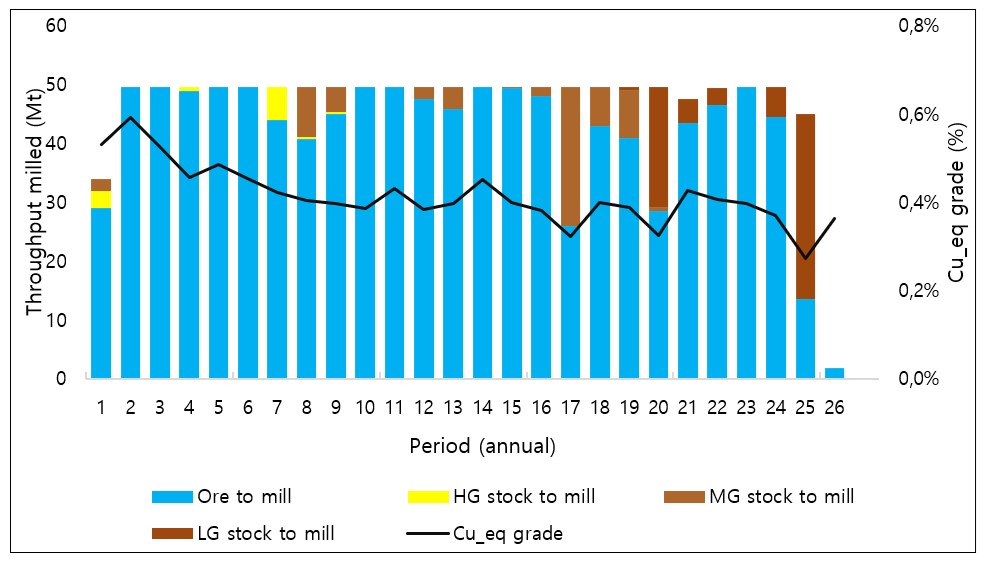
The open pit would have a mine life of 26 years, operating 365 days a year with a life of mine strip ratio of 2.33:1 (including pre-stripping). The production plan would be based on the steady state processing of 49,640,000 tonnes per annum of ore. Once steady state production is reached, variations in cash-flow are due primarily to variations in head grade, strip ratio and recoveries.
The mined production profile, followed by the milled production profile, is presented below. Ores below variable mill cut-off grade are stockpiled in either high-grade, medium-grade or low-grade stockpiles and are subsequently rehandled and combined with mine feed to the mill.
To view an enhanced version of this graphic, please visit:
Processing
Vizcachitas is a copper-molybdenum porphyry where its main copper species are primary sulphides. An optimal liberation is achieved at a P80 of 240 microns. Low presence of clays favours flotation and water recovery performance. These key ore characteristics allow the Project to:
Consume less energy in the grinding stage compared with other porphyries (10.8 kWh/t in the grinding stage and 16.6 kWh/t overall) with the use of the HPGR technology and with a target P80 of 240 microns.
Achieve recoveries over 90% (average of 91.1%), producing clean concentrates.
Use of filtered tailings technology to achieve a cake moisture of 15%. This results in substantial reductions of water consumption (below 0.2 m3/t) and dry tailings that do not require building a tailings dam, thus reducing the Project footprint, environmental impact and seismic risks.
The low altitude of the Project avoids the need for de-rating of equipment. Gravitation will be used to send ore from the crusher to the flotation plant which will also reduce energy consumption.
The Flotation area will be located downstream from the crushing plant in a natural plateau on the east side of the valley.
Infrastructure
The Project is located in an infrastructure-dense region. Connection to the national grid would be via a 60km line. Concentrates would be transported in rotainers by truck 145km to the Port of Ventanas with the Ports of Valparaiso and San Antonio as additional options. There are 35km of existing roads that would require upgrading between Vizcachitas and Putaendo. Rail transportation from San Felipe to any of the three ports is a further alternative to be evaluated.
A site camp is not required for lodging due to a reduced commuting time to nearby towns and cities (Putaendo, San Felipe and Los Andes) which have skilled mining workforces.
Tailings would be dry stacked in layers with the mine waste rock in a co-mingled configuration. The Tailings Storage Facility would be located across the valley allowing the loaded waste mine trucks to operate in a favourable slope. The use of dry-stacked filtered tailings would reduce water consumption by approximately 50% (from the previous design), limit its footprint to one valley, and discard the use of tailings dams, minimizing seismic risk and environmental impacts.
The Rocin River would be diverted by a 40m high dam and a 5m diameter and 16.2km long tunnel. The Company signed a Letter of Intent with Desala Petorca SPA, a water supply company which will provide desalinated water to the Project thereby removing any concern over use of continental water in drought afflicted area.
Detailed PFS Economic Results
Metric UoM First 8 years* LOM Pre-tax NPV (8%, Real 2023) USD M 3,999 Post-tax NPV (8%, Real 2023) USD M 2,776 IRR pre-tax % 28.5% IRR post-tax % 24.2% Undiscounted Post-tax Cash Flow (LOM) USD M 9,484 Payback period Years 2.5 Initial CAPEX USD M 2,441 LOM Sustaining CAPEX (excluding closure) USD M 1,494 LOM C1 Cash Costs USD/lb Cu 0.93 1.25 Nominal Process Capacity (Annual) Ktpa 49,640 Nominal Process Capacity (Daily) tpd 136,000 Mine Life Years 26 First Concentrate Production Years Year 4, Q2
Ore Grade
| Cu Grade | % | 0.46 | 0.36 |
| Mo Grade | g/t | 141 | 136 |
| Ag Grade | g/t | 1.3 | 1.1 |
| Cu Equivalent Grade | % | 0.52 | 0.41 |
Metal Production
| Cu in concentrate | kt | 967 | 3,975 |
| Mo in concentrate | kt | 24 | 124 |
| Ag in concentrate | koz | 7,275 | 32,712 |
Average Process Recovery
| Cu Recovery | % | 91.1% | 91.1% |
| Mo Recovery | % | 74.3% | 74.8% |
| Ag Recovery | % | 75.0% | 75.0% |
Physicals
| Total in-situ rock | kt | 1,251,832 | 4,075,302 |
| Waste rock | kt | 809,883 | 2,855,370 |
| Ore mined (all grades) | Kt | 294,701 | 1,219,932 |
| Strip ratio | w:o | 1.54* | 2.33 |
Annual Average Production
Copper t Cu 183,017 152,883
- Strip ratio for first 8 years excludes pre-stripping (included in CAPEX).
The cost breakdown of significant activities relating to the Project is presented in the table below.
| UoM | First 8 years | LOM | |||
|---|---|---|---|---|---|
| Sales income* | USD/lb Cu | 4.10 | 4.16 | ||
| Selling expenses | USD/lb Cu | - | (0.60) | - | (0.61) |
| Gross revenue | USD/lb Cu | 3.50 | 3.55 | ||
| Mining cost | USD/lb Cu | - | (0.47) | - | (0.71) |
| Processing cost | USD/lb Cu | - | (0.46) | - | (0.54) |
| C1 cost | USD/lb Cu | - | (0.93) | - | (1.25) |
| Surface infrastructure | USD/lb Cu | - | (0.14) | - | (0.17) |
| Indirects | USD/lb Cu | - | (0.04) | - | (0.04) |
| Royalty | USD/lb Cu | - | (0.09) | - | (0.10) |
| C3 cost | USD/lb Cu | - | (1.19) | - | (1.56) |
| Sustaining CAPEX | USD/lb Cu | - | (0.34) | - | (0.17) |
| All-in sustaining costs (AISC)** | USD/lb Cu | - | (2.13) | - | (2.35) |
| AISC margin | % | 48% | 44% | ||
| All-in sustaining profit | USD/lb Cu | 1.96 | 1.82 | ||
| Initial CAPEX | USD/lb Cu | - | (0.28) | - | (0.28) |
| First category tax | USD/lb Cu | - | (0.36) | - | (0.42) |
| All-in costs (pre-tax) | USD/lb Cu | - | (2.77) | - | (3.04) |
| AiC margin | % | 32% | 27% | ||
| All-in margin | USD/lb Cu | 1.33 | 1.12 |
- Sales income include by-products. **AISC include all cash costs, sustaining capital and selling costs, but excludes head office G&A, exploration
expenses.
Future opportunities and value enhancements
The PFS identified a number of potential optimizations to the Project. These include:
Further drilling to reclassify Inferred Resources to Measured and Indicated Resources and so incorporate them into the mine plan Further drilling to define the extent of the mineralization both laterally and at depth
Both can potentially extend the mine life without expanding plant and infrastructure.
The use of rotainers to transport the concentrate creates a number of options to transport the concentrate to port. The base case currently contemplates trucking to the Port of Ventanas. Rotainers open the possibility of accessing (with minor incremental port handling investments) the ports of Valparaiso and San Antonio. The potential to use rail from San Felipe to any of these three ports is additional option, to be evaluated further.
QAQC Statement
Los Andes Copper has a strict Quality Assurance and Quality Control ("QA QC") protocol consistent with industry best practices for core handling. There is a strict chain of custody from the Project site to the laboratory via the Company's core cutting facility. The QA QC protocol includes inserting field duplicates, coarse duplicates, pulp duplicates, pulp and coarse blanks and Certified Reference Materials supplied by Ore Research and Exploration, Australia.
Qualified Persons
The contents of this press release have been reviewed and approved by each of Severino Modena, Maria Loreto Romo, Sergio Alvarado, Mario Riveros, and Ricardo Muñoz, each of whom is a Qualified Person as such term is defined in NI 43-101 of the Canadian Securities Administrators (the "QPs"). Each of the QPs is an employee or consultant working for Tetra Tech Sudamérica S.A., which was engaged by the Company to prepare the PFS.
Antony Amberg CGeol FGS, the Company's Chief Geologist, has also reviewed and approved the scientific and technical information contained in this news release, and has validated the data by, supervising the sample collection process, through chain of custody records and inspecting the detailed technical data and quality control and assurance information.
About Los Andes Copper Ltd.
Los Andes Copper Ltd. is an exploration and development company with an 100% interest in the Vizcachitas Project in Chile. The Company is focused on progressing the Project, which is located along Chile's most prolific copper belt, into production. Vizcachitas is one of the largest copper deposits in the Americas not controlled by the majors and the Company believes it will be Chile's next major copper mine. The Project is a copper-molybdenum porphyry deposit, located 150 kilometers north of Santiago, in an area of very good infrastructure. An independent technical report for the PFS, prepared in accordance with NI 43-101, will be available under the Company's SEDAR profile within the next 45 days.
Los Andes Copper Ltd. is listed on the TSX-V under the ticker: LA.
For more information please contact:
Santiago Montt, Interim CEO [email protected]