
Banyan Gold Intersects High-Grade Mineralization at Newly Identified Roaring Fork Zone, Visible Gold at Seattle Creek Zone, Nitra Project, Yukon
Banyan Gold Intersects High-Grade Mineralization at Newly Identified Roaring Fork Zone, Visible Gold at Seattle Creek Zone, Nitra Project, Yukon
VANCOUVER, BC / ACCESS Newswire / July 28, 2026 / Banyan Gold Corp. (the "Company" or "Banyan") (TSX-V:BYN)(OTCQB:BYAGF) is pleased to announce it has intersected visible gold and high-grade mineralization in its first exploration drillholes at the Nitra Gold Project ("Nitra"). These intersections have potentially identified new discoveries within the Roaring Fork zone and Seattle Creek zone at Nitra, approximately 25 km west of the AurMac Deposit on claims owned 100% by Banyan with no underlying royalties. These are the first two of eleven exploration targets that Banyan has identified on it's broader 830 sq km AurMac and Nitra land packages in the Mayo Mining District, Yukon.
Highlights from Roaring Fork Zone at Nitra:
NT-26-001 - 1.62 g/t Gold ("Au") over 5.0 metres ("m");
including high-grade of 17.80 g/t Au over 0.4m *
*Note: This release contains gold fire assays from top of hole to 285m, see text below.
"We are very excited to report The Roaring Fork Discovery at Nitra, indicating a new mineralized system 25 km west of the AurMac footprint (Figure 1)," stated Tara Christie, President and CEO. "Diamond drillhole NT-26-001 intersected visible gold, high densities of mineralized extensional veining and high-grade gold mineralization associated with quartz veins and bismuth-sulphosalts similar to what we see at AurMac and within the top 80 metres from surface. We are also pleased to announce a second target zone approximately 5 km north at Seattle Creek, with large extensional quartz veins with multiple visible gold instances, bisthmuth sulphosalts, and sulphide replacement style mineralization of calcareous metasedimentary rocks. While it is early days in understanding the scope of these discoveries, we are seeing similar vein hosted mineralization in adjacent drillholes."
In June 2026, Banyan announced the commencement of its greenfields exploration diamond drilling program at Nitra. The Nitra project benefits from a network of extensive roads established by previous and ongoing placer mining activities near the targets. The diamond drill program is utilizing two helicopter supported drills to minimize initial footprint and expedite testing of the targets. Over 7,500 metres of drilling will be completed to test 11 regional targets identified through new geophysical surveys, soil geochemical anomalies, knowledge of placer-mining locations, and prospecting. The objective of the program is to identify potential satellite deposits by discovering additional expressions of Reduced Intrusion-Related Gold Systems ("RIRGs") in the highly prospective greenfields zones surrounding the AurMac deposit, where over 95% of the district-scale AurMac and Nitra land package remains untested by drilling. A third drill is being mobilized to site to accelerate the greenfields exploration program.
"The rocks at the Roaring Fork Zone and Seattle Creek have all the geologic ingredients we are looking for in our targeting," stated Duncan Mackay, Vice President Exploration. "A difference from AurMac is the presence of highly altered and strained volcanic rocks (Figure 3), amongst the typical metasedimentary rocks of the Yusezyu Formation which are a prime host for brittle strain and quartz vein emplacement. We are seeing abundant mineralized shear veins with secondary extensional veins overprinting, and local high-grade gold with anomalous gold throughout the portion of the hole for which we have received assays (Figures 5 and 6). Numerous instances of visible gold, high-grade gold intervals, a late lamprophyre dyke (indicative of a long-lived structural corridor), and notable shear and extensional veins hosting bismuth-sulphosalts on our first, second, and sixth drillholes of the regional exploration program is very encouraging for the success of our additional 9 targets (Figures 1 and 2) generated by our team and supplemented with machine learning (AI)."
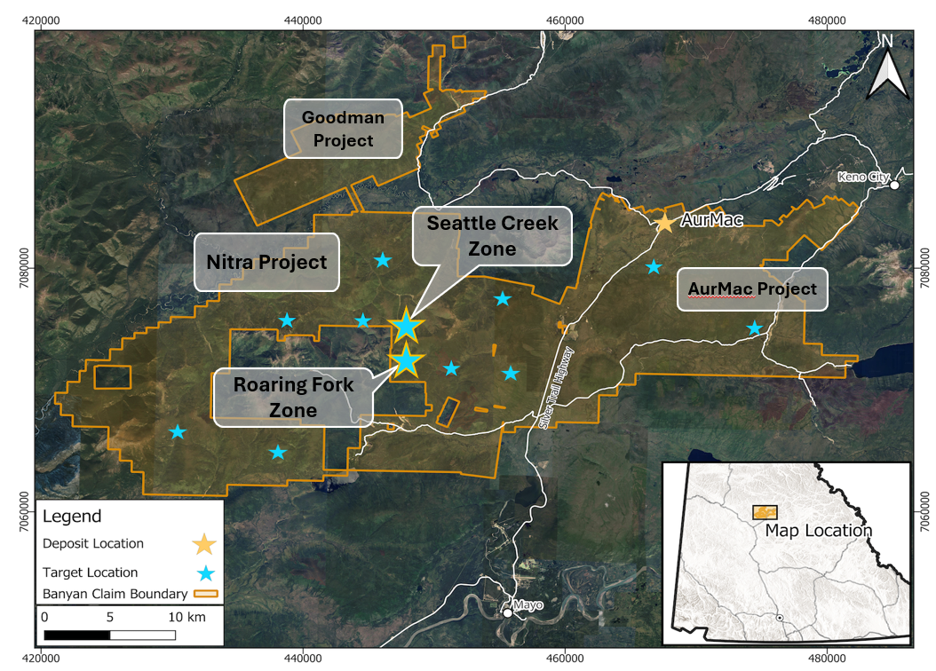
Figure 1: Location of the Roaring Fork Zone (Figure 2) and Seattle Creek Zone (Figure 7) in Nitra, approximately 25km west of AurMac.
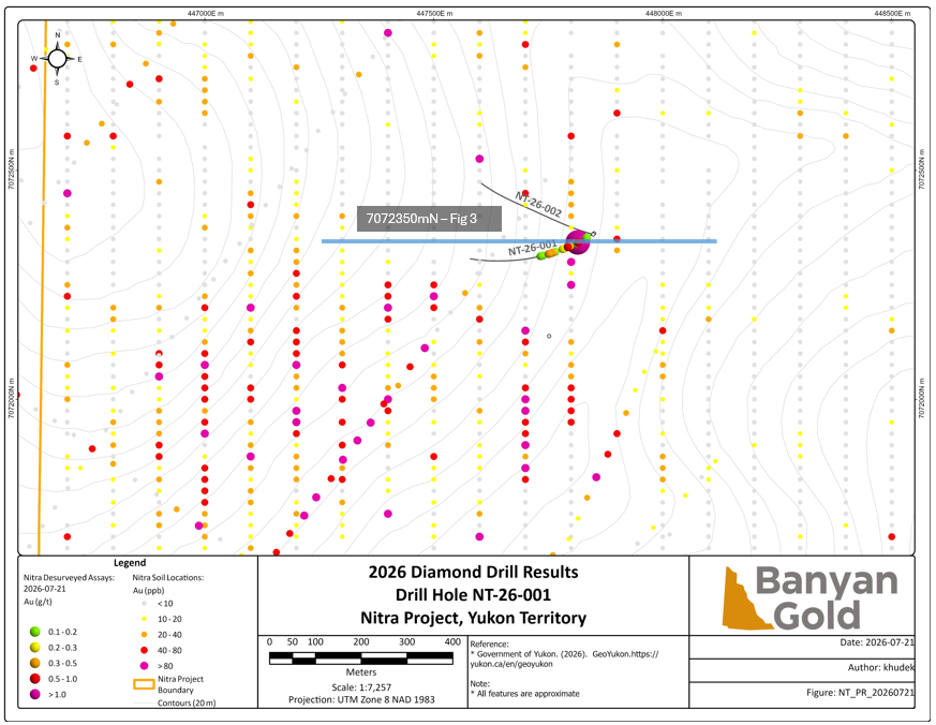
Figure 2: Plan map of Roaring Fork Zone in Nitra. Drill hole traces for NT-26-001 and -002. De-surveyed partial assay values for NT-26-001 shown with surface soil sample anomalies highlighted. Cross section denoted by blue line (Figure 3).
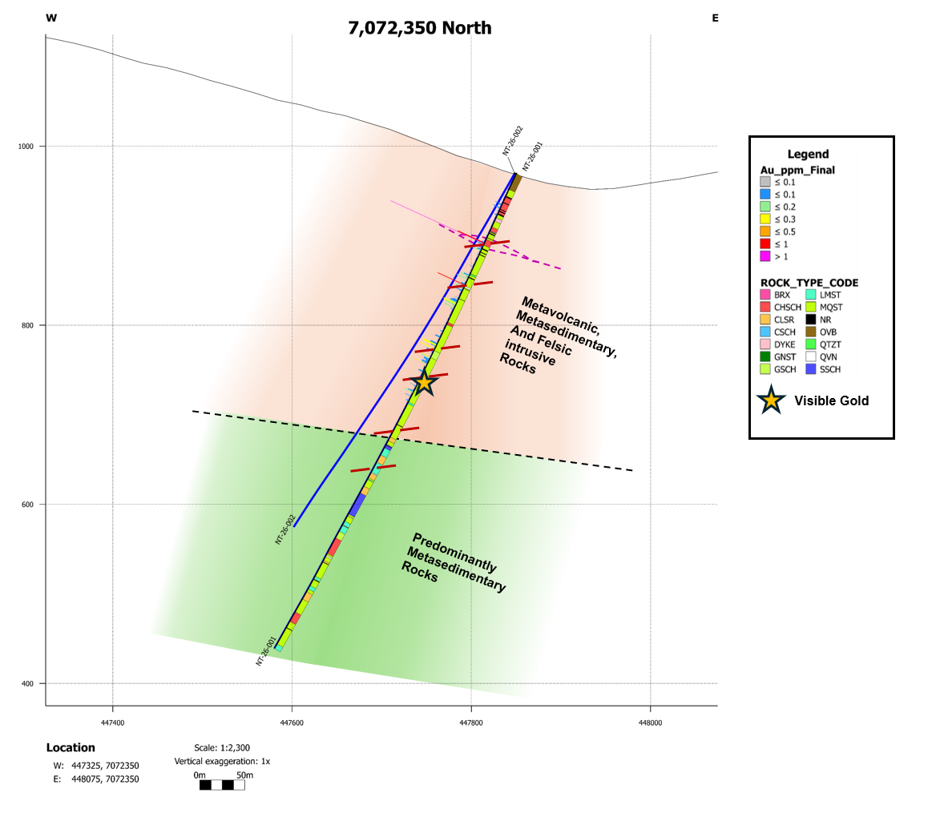
Figure 3: Cross sections 7072350N - Drillholes NT-26-001 and -002(results pending) are shown. There is a change in rock-type approximately mid-way downhole with folded and highly-strained mixed metavolcanic, metasedimentary, felsic dyke rocks giving way to predominantly metasedimentary rocks dominated by chlorite and moderate grade metamorphic minerals (sillimanite, andalusite, possible retrograde cordierite). Stratigraphy is dipping moderately (~40-45 deg) slightly east of south (approx. 160-170 deg). Extensional veins are dipping moderately (20-35 deg) slightly west of north (340-360). Extensional veins and mineralized shear veins are concentrated in the top 300m of the drill holes (note red traces for extensional veins).
A combination of soil geochemical anomalies (Gold, Bismuth, Arsenic) and geophysical signatures (resistive anomaly) were used to identify the target at Roaring Fork Zone. These targeting indicators were combined with proximal placer mining in the creek drainage to locate and prioritize the targets. Mineralization at Roaring Fork Zone is predominantly hosted in two styles of quartz vein; cross-cutting extensional veins hosting bismuth sulphosalts, arsenopyrite, pyrite, and locally sphalerite (Figure 5), and foliation sub-parallel shear veins hosting bismuth-sulphosalts, arsenopyrite, pyrite. Quartz veins are most concentrated near the margins of deformed and altered volcanic units, which may act as rigid buttresses to concentrate mineralizing fluids and favourable local strain regimes allowing for vein emplacement. The top 300m of drillhole NT-26-001 exhibited the favourable mineralization; the lower 300m of the drillhole was extended to test additional shear veins identified during daily quick-logging and to provide greater geologic context for the area and for future drilling. Outcrop exposure is very limited across Nitra, with no outcrop within 200m of the drill collar.
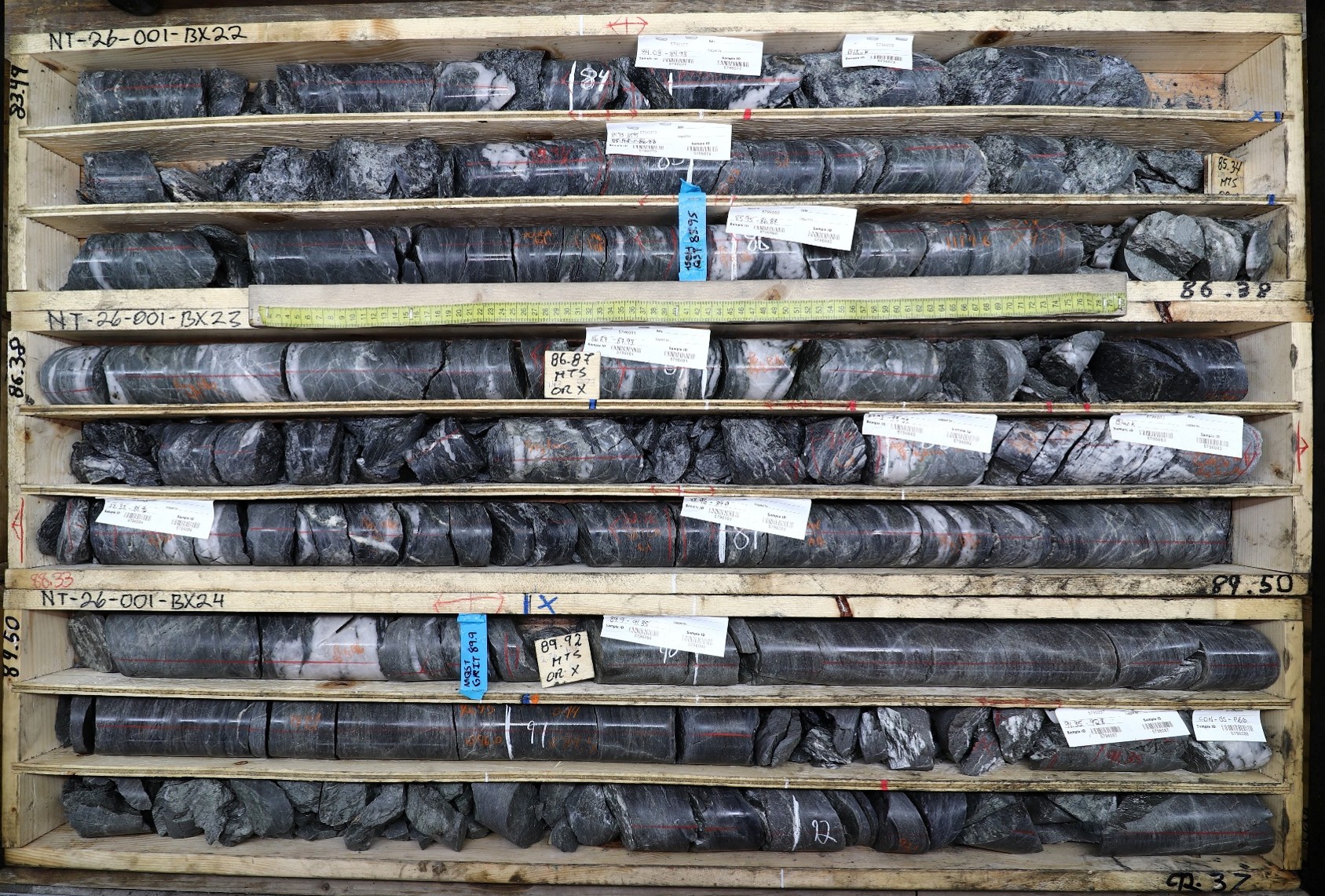
Figure 4: Mineralized shear and extensional quartz veins in metasedimentary and metavolcanic rocks in drill hole NT-26-001 from Nitra. Numerous quartz veins in the top 300m of the drill hole host bismuth-sulphosalts, arsenopyrite and locally visible gold (Figure 5).
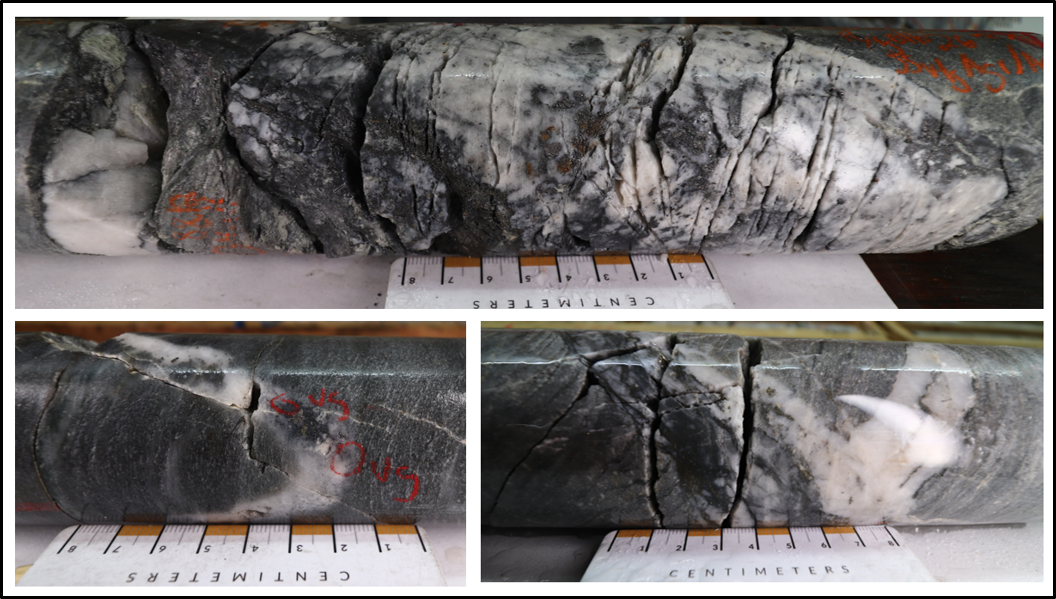
Figure 5: Examples of veining intersection in drillhole NT-26-001: Top - 88.0m - large extensional quartz vein with abundant bismuth-sulphosalts, sphalerite, arsenopyrite, and pyrite. Initial assays returned values of 17.8 g/t Au for 87.9-88.3m. Bottom Left 266.7m - centimetre-scale extensional quartz vein hosting bismuth-sulphosalts with intergrown visible gold (Figure 6), arsenopyrite, and pyrite. Initial assays returned values of 0.13 g/t Au from 266.4-266.7m. Bottom right - 162.9m - centimetre-scale extensional quartz vein with sulphosalts, arsenopyrite, and associated foliation sub-parallel quartz shear vein. 0.28 g/t Au from 162.9-163.3m.
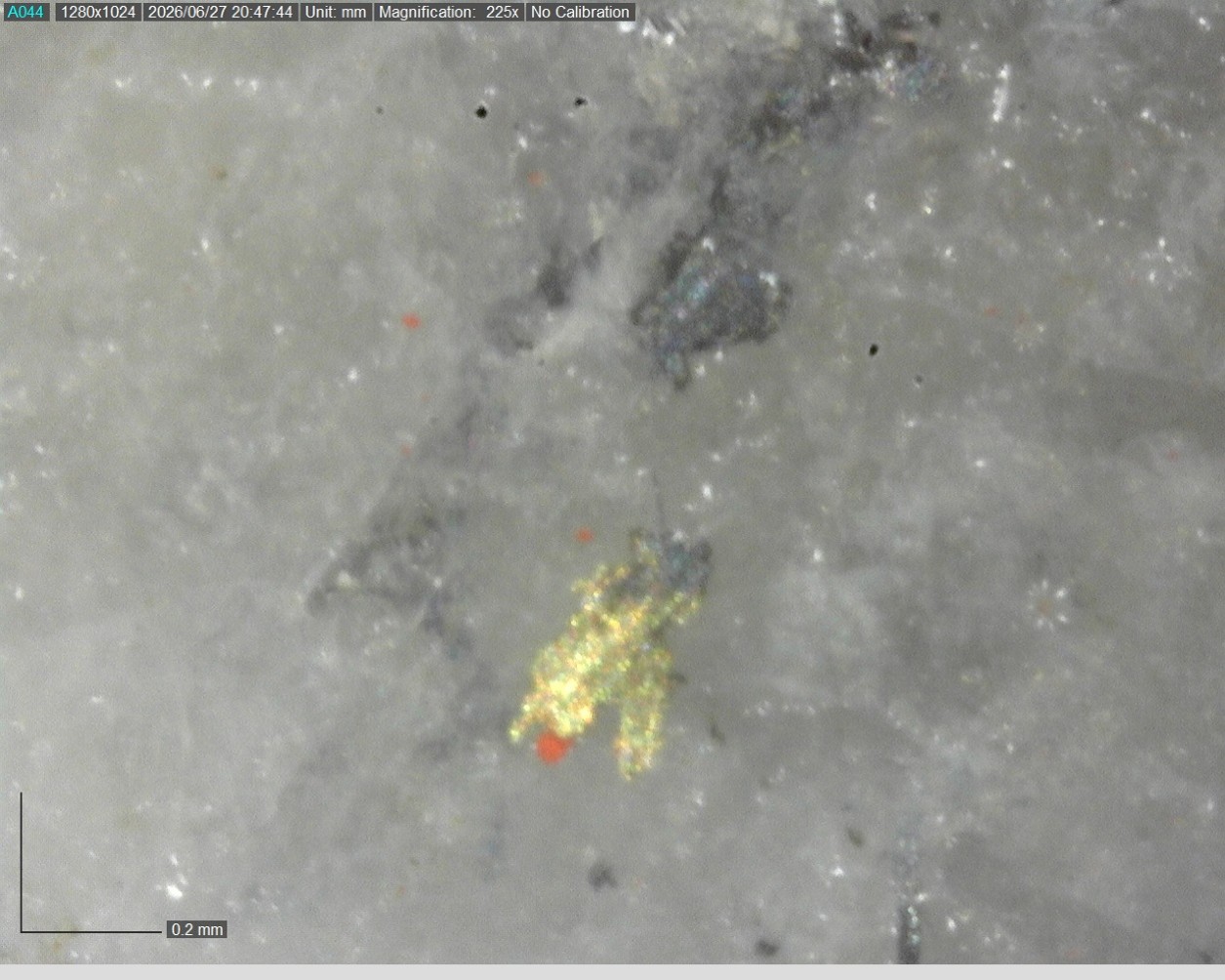
Figure 6: Visible Gold from NT-26-001 266.6m within extensional quartz vein. Gold grain is intergrown with bismuth-sulphosalts.
Seattle Creek Zone
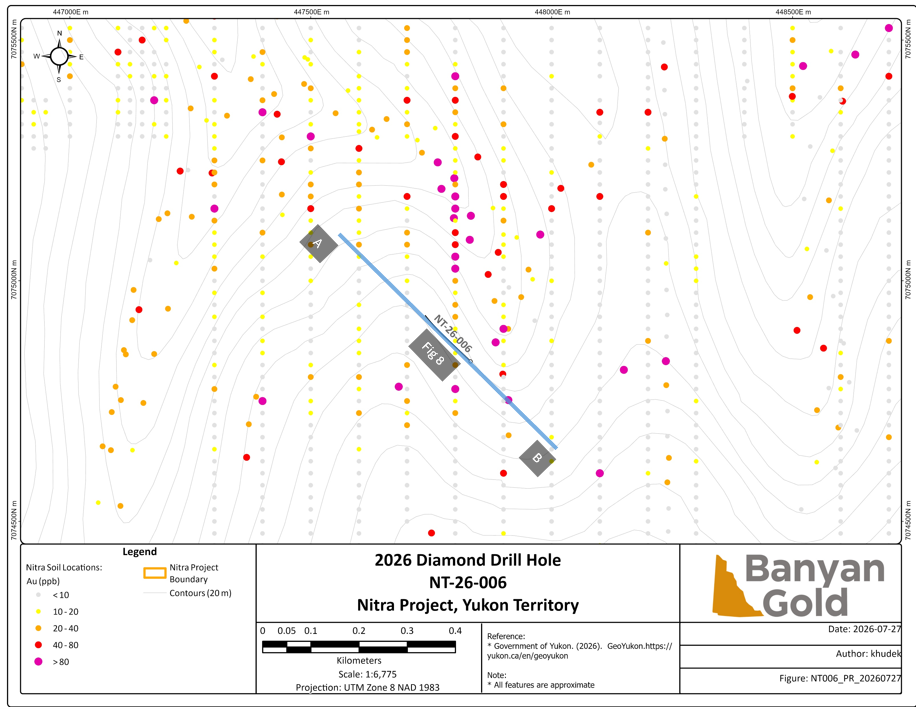
Figure 7: Plan map of Seattle Creek Zone in Nitra. Drill hole traces for NT-26-006 shown. Blue line denotes cross section (Figure 8).
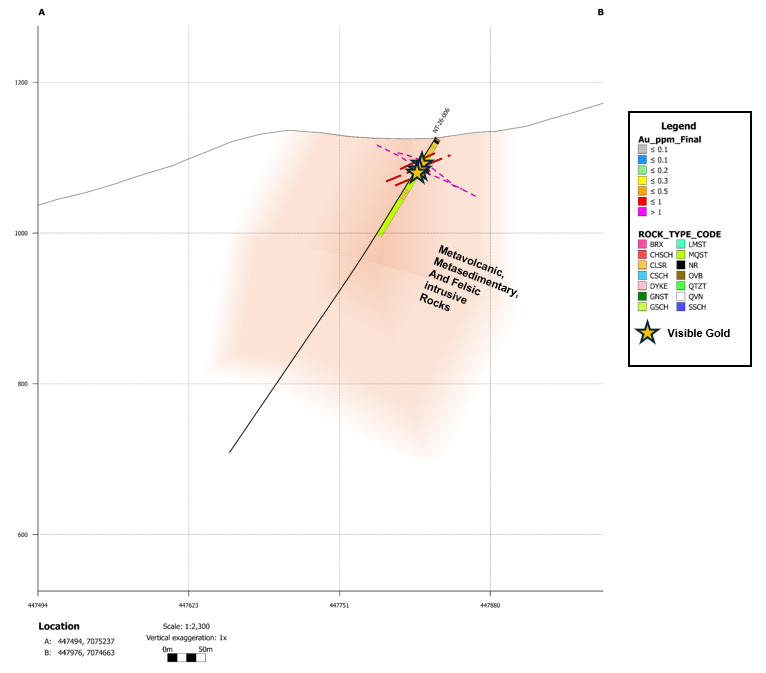
Figure 8: Cross Section A-B in Figure 7 - Seattle Creek Zone - Nitra. Numerous visible gold occurrences in potential mineralized zone between 40m and 60m primarily hosted in metasedimentary and metavolcanic rocks. Stratigraphy is dipping moderately (~35-45 deg) to slightly east of south (approx. 165-170 deg). Extensional veins are dipping moderately (30-50 deg) slightly west of north.
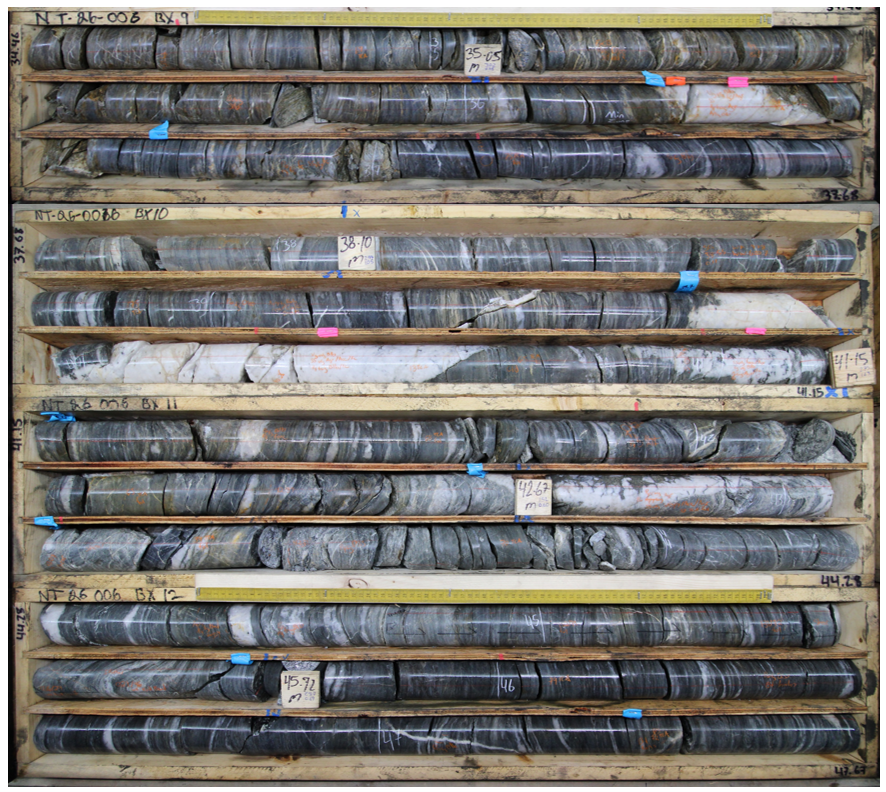
Figure 9: Mineralized extensional quartz veins in predominantly metasedimentary rocks in drill hole NT-26-006 from Nitra. Quartz veins in the host visible gold, bismuth-sulphosalts, arsenopyrite and locally visible gold (Figures 10 and 11).
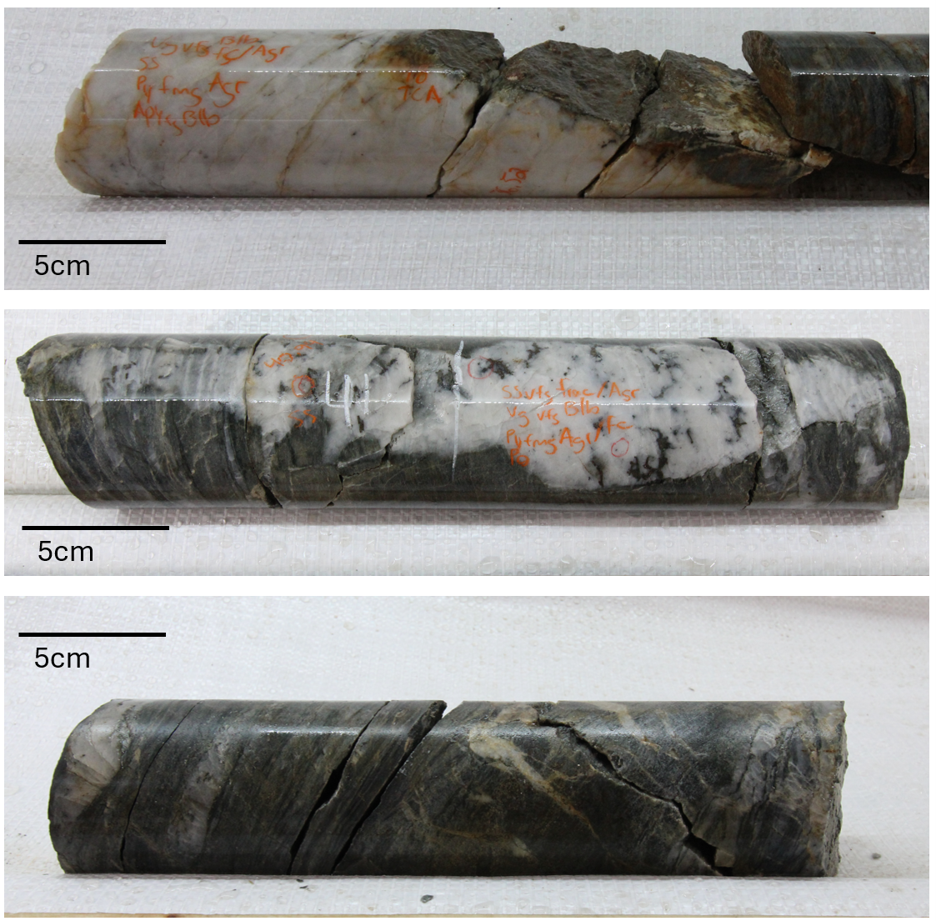
Figure 10: Potential mineralized intervals from drillhole NT-26-006: Top - 36.2-36.7m - extensional quartz vein bearing visible gold, bismuth sulphosalts, arsenopyrite, and pyrite. Middle -40.9-41.2m - extensional quartz vein bearing visible gold, bismuth sulphosalts, pyrrhotite, and pyrite. Bottom - 41.9-42.2m - local quartz shear veins and extensional quartz-carbonate veins associated with calc-silicate alteration and pyrrhotite, arsenopyrite, pyrite sulphide replacement of calcareous metasedimentary rocks.
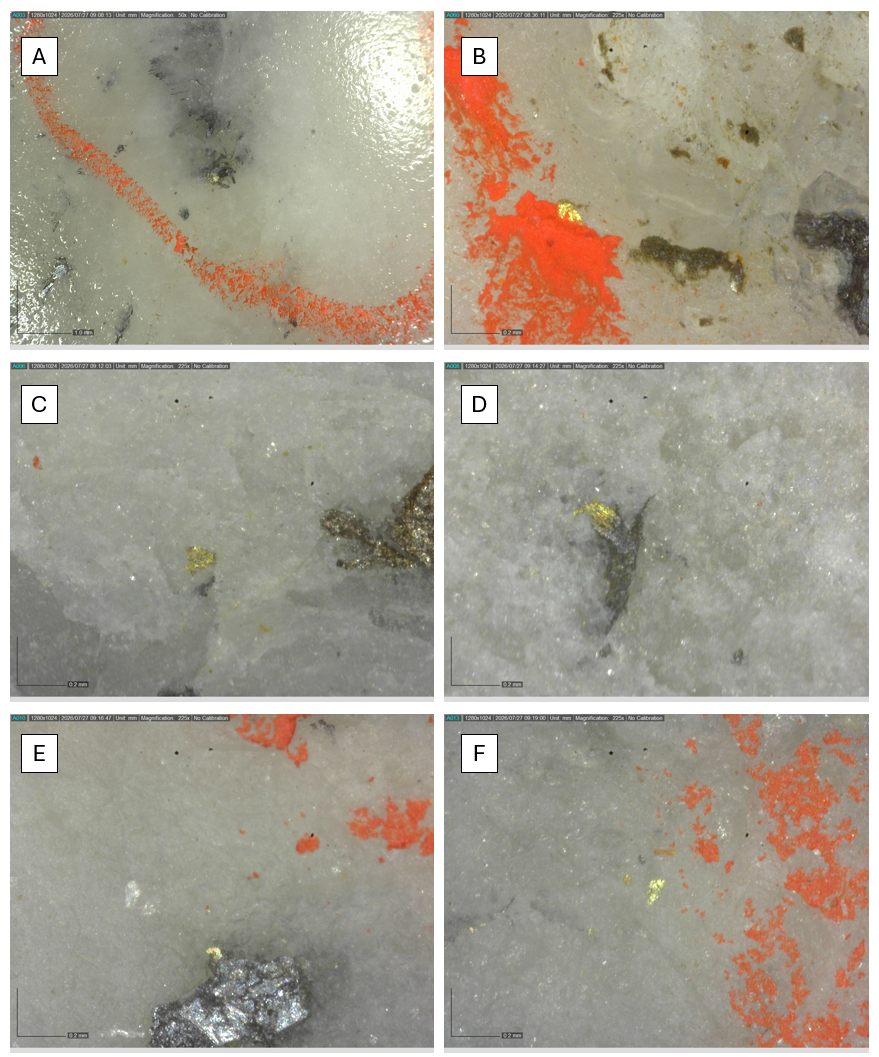
Figure 11: Visible gold occurrences from diamond drillhole NT-26-006 at Nitra. A) 40.4m visible gold intergrown with acicular bismuth sulphosalts. B) 40.9m visible gold spatially associated with pyrrhotite, arsenopyrite, and bismuth sulphosalts. C) and D) 41.0m visible gold spatially associated with pyrrhotite and intergrown with bismuth sulphosalts grains. E) 52.7m visible gold intergrown with arsenopyrite grain. F) 52.7m visible gold in extensional quartz vein.
Table 1: Intervals from Nitra - Roaring Fork Zone
| HOLE NUMBER | depth from |
| depth to |
| Au Interval (m) |
| Au Interval (g/t) |
| NT-26-001 | 84.9 |
| 89.9 |
| 5.0 |
| 1.62 |
| including | 86.9 |
| 88.3 |
| 1.4 |
| 5.36 |
| including | 87.9 |
| 88.3 |
| 0.4 |
| 17.80 |
| and | 127.4 |
| 147.4 |
| 20.0 |
| 0.10 |
| and | 159.7 |
| 169.0 |
| 9.3 |
| 0.15 |
| and | 212.8 |
| 224.0 |
| 11.2 |
| 0.13 |
| and | 230.2 |
| 239.3 |
| 9.1 |
| 0.11 |
Note: Calculated true widths are approx. 80% of drill intervals. Further drill intersections and modelling will confirm orientation of mineralized domains.
Only assay for top 285m of the drillhole have been received to this time; assay for the lower half of diamond drill hole NT-26-001 and all of NT-26-002 and NT-26-006 are pending.
Table 2: Collars for diamond drillholes in this release
| Hole ID | Easting (m) |
| Northing (m) |
| Elevation (m) |
| Length |
| Azimuth |
| Dip |
| NT-26-001 | 447850 |
| 7072362 |
| 984 |
| 600.5 |
| 240 |
| -60 |
| NT-26-002 | 447850 |
| 7072362 |
| 984 |
| 495 |
| 285 |
| -60 |
| NT-26-006 | 447831 |
| 7074832 |
| 1127 |
| 500 | * | 310 |
| -60 |
*note: drillhole 26-006 is currently drilling with expected shutdown target of 500m.
Analytical Method and Quality Assurance/Quality Control Measures
The reported work was completed using industry standard procedures, including a quality assurance/quality control ("QA/QC") program consisting of the insertion of certified reference materials, field duplicates and coarse blanks into the sample stream and utilizing certified independent analytical laboratories for all assays. Additionally, historic QA/QC data and methodology on the AurMac Project were reviewed and will be summarized in the Technical Report. The qualified persons detected no significant QA/QC issues during review of the data.
A robust system of standards, core duplicates and coarse blanks, was implemented in all Banyan drilling programs and was monitored as chemical assay data became available. All control samples were within accuracy and precision thresholds required to meet data quality standards. These control samples amounted to approximately 10% of all samples submitted to analytical laboratories.
All diamond drill core was systematically logged and photographed by Banyan geology personnel. All core samples (HTW and NTW diameter) were split on-site at Banyan's core processing facilities. Once split, half samples were placed back in the core boxes with the other half of split samples sealed in poly bags with one part of a three-part sample tag inserted within. Samples were delivered by Banyan personnel or a dedicated expediter to the Bureau Veritas, Whitehorse preparatory laboratory where samples are prepared and then shipped to Bureau Veritas's Analytical laboratory in Vancouver, B.C. for pulverization and final chemical analysis.
Core splits reported in this news release were analysed by Bureau Veritas of Vancouver, B.C., utilizing the four-acid digestion ICP-ES 45-element MA-200 or ICP-ES/MS 59-element MA-250 analytical package with FA-450 50-gram Fire Assay with AAS finish for gold on all samples. Samples returning >10 g/t Au were reanalysed by fire assay with gravimetric finish on a 50g sample (FA-550). High-grade samples with documented visible gold are also analysed using metallic screen fire assay (FS-652). Samples returning >200 g/t Ag (MA250 or MA300) were analysed by multi-acid digestion ICP-ES MA370. If samples returned > 1,500 g/t Ag, they were analysed by fire assay with gravimetric finish on a 50g sample (FA550). If samples returned > 10,000 g/t Ag, they were analysed by fire assay 2g sample (FA501). Bureau Veritas is an accredited lab following ISO/IEC 17025:2017 SCC File Number 15895. A robust system of standards, ¼ core duplicates and blanks has been implemented in the 2026 exploration drilling program and is monitored as chemical assay data becomes available.
Qualified Persons